Clara’s Verdict
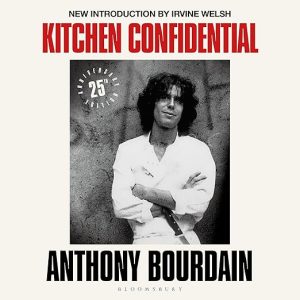
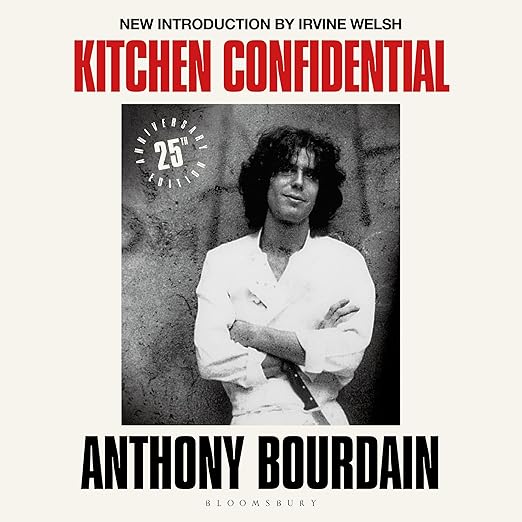
Anthony Bourdain was many things – chef, novelist, documentary presenter, cultural provocateur – and Kitchen Confidential was the book that made people outside the restaurant industry pay serious attention to all of it. Twenty-five years after its first publication, it has not aged badly. The specific kitchens Bourdain describes are mostly gone, some of his attitudes belong to an era that has rightly moved on, and a few of the war stories now read as the confessions of a young man performing toughness he would later complicate. None of this undermines the book, because the writing is exceptional and the self-portraiture is honest to the point of discomfort. This 25th anniversary edition adds an introduction from Irvine Welsh, which is either inspired or peculiar casting depending on your perspective. I lean towards inspired: both writers share an interest in outsiders, excess, and the particular honesty that comes from having nothing much left to conceal.
About the Audiobook
The book tracks Bourdain’s life from a revelatory childhood oyster in the Gironde – the moment he understood what food could mean, could be – through dishwashing jobs on the Cape, culinary school, years of chemical excess and lateral employment, and eventually the position of executive chef at Brasserie Les Halles in Manhattan. What emerges is less a culinary memoir than a portrait of a subculture: the brutal hierarchy of professional kitchens, the camaraderie forged under pressure, the particular madness required to do the same precise things correctly, five hundred times a night, for years on end without losing your mind or your standards.
The 25th anniversary edition includes a new introduction from Welsh, who sets the tone elegantly. His introduction acknowledges the darkness in Bourdain’s story while refusing to sentimentalise it, which is exactly right. The Bourdain prose that follows is sharp, funny, occasionally shocking, and always grounded in physical reality – this is a writer who understood that good food writing earns its pleasures through specificity, not impressionism. The comparison to Elizabeth David written by Quentin Tarantino, credited to A.A. Gill, is one of the finer capsule reviews in the history of book blurbs.
The Narration
Bourdain reads his own work, and the result is irreplaceable. His voice – slightly hoarse, sardonic, capable of unexpected tenderness – is the voice of someone who knows exactly what he is confessing and has decided to confess it anyway, without apology or excessive self-flagellation. The pacing is confident, the performance entirely unaffected. There is a quality to self-narrated memoirs when the author is a genuine storyteller, and Bourdain was that in the most unqualified sense. Irvine Welsh reads his own introduction, which is a further bonus. At eight hours and thirty-seven minutes, this never outstays its welcome.
What Readers Say
Rated 4.6 out of 5 stars across 25 reviews, with consistent praise for both the writing and the narration. One reviewer described Bourdain as “a tortured soul totally at odds with most aspects of being a regular functioning human being” and found that quality precisely the source of the book’s appeal: “He has a gift for story-telling and self-effacing behaviour that I find very appealing in a writer and for that matter a person.” Another noted that the first half is near-perfect but that the second loses some momentum – a fair assessment, though the momentum loss is relative. The review headlined “Why did you leave us so early?” captures the affection and grief that now attaches to Bourdain’s work. Multiple reviewers named it their book of the year. The lone more critical voice found his expectations simply too high, rather than the book itself disappointing.
Who Should Listen?
If you work in hospitality, or have ever been curious about what professional kitchens are actually like beneath the television surface, this is essential listening and always has been. The book has been required reading in culinary schools and among chefs for a quarter of a century, and for good reason: there is no comparable account of the professional kitchen at ground level, from someone who spent years in it rather than observing it from the dining room. Beyond that specialist audience, it rewards anyone who enjoys sharp, self-aware writing about obsession and craft – the kind of book that uses food as a lens to examine what drives people to extreme and sometimes self-destructive dedication to their work. Readers of other great outsider memoirs – from Patti Smith’s Just Kids to Keith Richards’s Life – will recognise the register immediately. Not suitable for those who want their memoirs comfortable, their narrators reliably sympathetic, or their depictions of professional life sanitised for external consumption. Very much suited to those who prefer all three to be honest and unvarnished.
Listen to Kitchen Confidential on Audible UK – the 25th anniversary edition, read by the author.