Clara’s Verdict
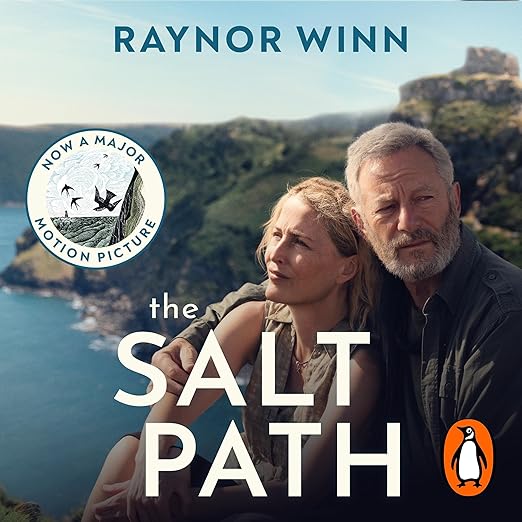
There are books that review themselves – titles so obviously and unanimously extraordinary that the critic’s job is less to assess than to direct. The Salt Path is one of those. Raynor Winn and her husband Moth walked 630 miles of the South West Coast Path after losing their home and learning that Moth had a terminal illness. Winn wrote it down. The result has sold over two million copies across all formats and languages, appeared on the Sunday Times list of the hundred best books of the past fifty years, and won the hearts of an extraordinary range of readers who don’t share much else in the way of taste. All of that is warranted. But the audiobook, narrated by Winn herself, adds something the print edition cannot: her actual voice, reading her own grief and her own stubborn hope, across nine hours. That is not a small thing.
About the Audiobook
The facts of the story are stark. Raynor and Moth Winn had farmed their land in Wales for thirty years. A legal dispute – complex, apparently catastrophic, and ultimately unwinnable – took everything. Simultaneously, Moth was diagnosed with corticobasal degeneration, a progressive neurological condition with no treatment protocol and a prognosis that should have sent them both home to rest and wait. Instead, with almost no money and no alternative they could live with, they bought rucksacks and started walking.
Winn writes about what walking 630 miles of cliff path does to a body, to a mind, to a marriage that has been tested by a decade of legal battle and then by a death sentence. She writes about homelessness without self-pity – they were wild camping, technically, which means they were not on the streets, but the precariousness was real and the encounters with housed people who couldn’t quite compute what they were looking at are some of the most quietly devastating passages in recent British memoir. She writes about grief: for the farm, for the life, for what she feared was approaching. And she writes about the strange reprieve that extreme physical challenge offered both of them.
Moth, who was expected to deteriorate rapidly, improved on the path. Winn does not present this as a miracle; she is too honest a writer for that. But she observes it, carefully and without overclaiming, and the observation carries its own kind of grace. Running time: 9 hours and 1 minute. The Guardian called it “beautiful, thoughtful, lyrical.” All three are accurate.
The Narration
Raynor Winn reading her own book is simply the correct choice, and Penguin Audio made the right call in asking her. Her voice is West Country in its warmth and directness. She reads without performance – there are no actorly swells at the emotional peaks, no calculated pauses for effect. The experience is of someone sitting across from you and telling you what happened, with the particular dignity of someone who survived it and is still somewhat surprised that they did. The landscape of Devon and Cornwall and Somerset comes through in the audio with an immediacy that matches the finest nature writing. If you have walked any part of the South West Coast Path, this will bring it back with uncomfortable precision. If you haven’t, it will make you want to go.
What Readers Say
Across 50 Audible ratings at 4.4 out of 5, responses share a common quality: readers who had no particular interest in walking memoirs or in the specific circumstances of the Winns’ story found themselves unexpectedly and deeply moved. One reviewer described it as “inspiring, heart breaking, delightful” – three things that rarely coexist but do here. Another praised the author’s refusal to lose her sense of humour through the hardest passages, noting the book was “everything I had hoped for after reading the excerpt.” A reader in Turkey summarised the experience in six words: “Inspiring, heart breaking, delightful.” A German reviewer admitted they had forgotten the book was non-fiction until they reached the final pages – which is, in its way, one of the better compliments a memoir can receive.
Who Should Listen?
Almost anyone. I say that knowing it sounds like a useless recommendation, but the breadth of readers this book has found – across languages, countries, and levels of interest in either walking or memoir – suggests that its appeal genuinely transcends its surface genre. If you have lost something you loved and had to keep moving regardless, you will recognise yourself in it. If you have stood on a clifftop on the south-west coast with the Atlantic in front of you, you will feel it again. The audiobook format is, I think, the ideal way to experience this particular story. Winn’s voice does work that no intermediary narrator could do in her place.
Listen to The Salt Path on Audible UK: Find it on Audible UK. Also available via Kobo, Scribd, and Storytel.