Clara’s Verdict
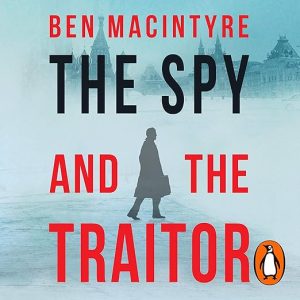
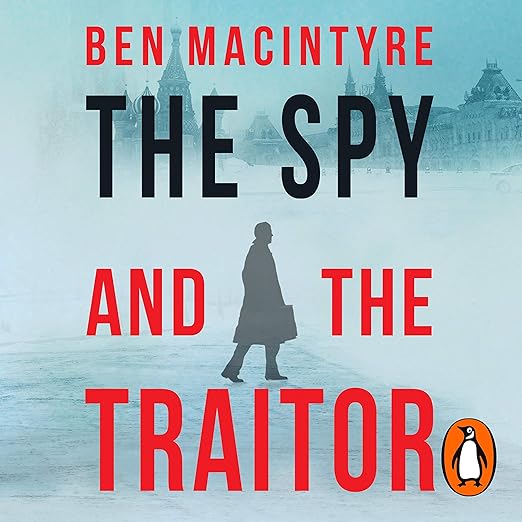
John le Carré called it “the best true spy story I have ever read,” and having listened to Ben Macintyre read his own account of Oleg Gordievsky aloud, I find it genuinely difficult to argue. The Spy and the Traitor is one of those rare non-fiction works that makes you slightly cross with the fictional version of a genre – because this story, which actually happened, is more tense, more morally complicated, and more cinematically constructed than most novels manage. Macintyre is the pre-eminent chronicler of British intelligence history, and this is by some distance his finest book. It is also, I should say plainly, one of the most gripping listens I’ve had in years. The fourteen-plus hours passed with the momentum of a thriller, which is exactly what it is – a true one.
About the Audiobook
The subject is Oleg Gordievsky, a senior KGB officer who, for more than a decade, fed a stream of priceless intelligence to his MI6 handlers – and who in July 1985 had to be smuggled out of Soviet Russia in one of the most audacious exfiltrations in the history of espionage. The operation, codenamed PIMLICO, involved a Safeway bag as a pre-arranged signal on a Moscow pavement, a family left behind under KGB surveillance, and a car-boot crossing of the Finnish border that remains almost unbelievable in its boldness. Macintyre reconstructs every stage of this with scrupulous sourcing and exceptional narrative control.
What elevates this beyond a conventional spy narrative is the weight Macintyre gives to the geopolitical stakes. Gordievsky’s intelligence was central to NATO’s understanding of how the Soviet leadership interpreted Western intentions during the early 1980s – a period of genuine nuclear anxiety that culminated in the Able Archer 83 war scare. The revelation that senior Kremlin figures genuinely believed a first strike from the West was imminent, and that Gordievsky’s counter-briefings helped correct that misunderstanding, gives the book a historical importance that extends well beyond its thriller qualities. The CIA officer who ultimately betrayed Gordievsky to the KGB – Aldrich Ames – haunts the later sections with a particular chill. The contrast between Gordievsky’s courage and Ames’s petty venality is one of the moral engines of the book.
The Narration
Macintyre reads his own work, which is always a gamble – authors don’t always make natural narrators, and a skilled voice actor will often serve a text better than its creator. In this case, however, authorial narration pays off handsomely. Macintyre brings an authority and quiet confidence to the material that a professional voice actor might have struggled to match; the sense that this is a man who spent years with his sources, who has sat across a table from Gordievsky himself, is palpable in every sentence. His pacing through the tenser sequences – particularly the exfiltration through Finland – is excellent: controlled, building, never melodramatic. He trusts the facts to do the dramatic work, and they do.
What Readers Say
With a 4.7-star rating from 31 reviews, listener enthusiasm is both broad and specifically felt. British readers were particularly struck by the immediacy of the historical proximity: “It’s astonishing to think that all this was unfolding while I was at school and university,” wrote one reviewer, “how terrifying to realise just how close we came to a Third World War, and what an extraordinary part Gordievsky played in preventing it.” Several noted they consumed it in near-continuous sessions. One more philosophically inclined reviewer observed that the nature of intelligence makes truth inherently slippery – a fair point that adds intellectual texture to the reading rather than diminishing it. The consensus is emphatic: this is a page-turner in the purest sense.
Who Should Listen?
Essential for anyone interested in Cold War history, modern British intelligence, or the moral psychology of espionage. Fans of le Carré’s fiction will find the real-world counterpart almost uncanny in its resonances – the bureaucratic paranoia, the slow accumulation of trust, the devastating weight of betrayal are all here, and all true. History readers who rarely venture into spy territory should make an exception: Macintyre writes rigorous history, not thriller-by-numbers. Get it on Audible UK – this is one I would recommend without hesitation to almost any reader.
A practical note on listening: this works superbly as a commute listen, precisely because the tension sustains across sessions in a way that most non-fiction does not. The narrative is structured with a thriller’s sense of pacing – Macintyre knows where his set pieces are, and he builds to them with craft. Listeners who prefer to complete books in large sittings will find it equally rewarding; the sense of momentum is consistent throughout. This is, in the broadest and most complimentary sense, unputdownable.
The book also benefits from Macintyre’s access to Gordievsky himself, who spoke with the author at length. That access means the account of Gordievsky’s inner life – his motivations for betraying the KGB, his complex relationship with Britain, his years of sustained fear – has an authority that secondary-source reconstruction could not match. It is one of the rare spy histories where the protagonist’s perspective is genuinely present throughout.