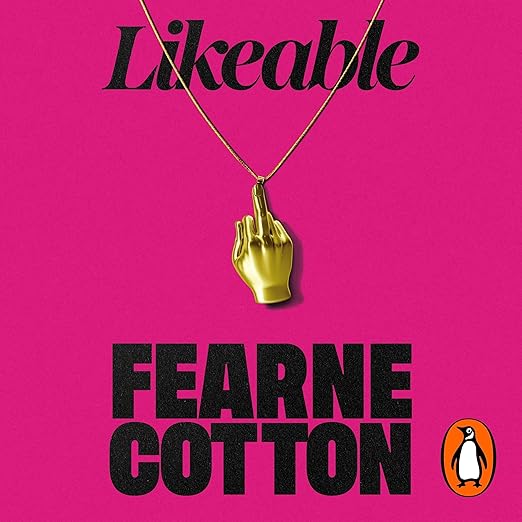
Clara’s Verdict
Fearne Cotton has been writing personal development books with a therapeutic lean for some years now, and Likeable feels like the one she has been building toward. The subject – people-pleasing, the compulsive need to be liked, the cost of chronically suppressing your own needs in service of other people’s comfort – is one of those universal human experiences that almost everyone recognises and almost nobody talks about directly. Cotton talks about it directly. The audiobook, narrated by the author, is an intimate and often surprisingly raw piece of work, and the listeners who found it most useful report that Cotton’s voice makes the difference: hearing her speak these truths, rather than reading them, somehow makes them more available.
About the Audiobook
Cotton writes in the first person throughout, threading her own experiences as a broadcaster who learned early that her professional success depended on being liked. She morphed into whoever people needed her to be, suppressed her own needs, took on responsibility for other people’s emotional states, and found – as people-pleasers reliably do – that it was unsustainable. The book is structured around the moment of asking a different question: not “what do they think of me?” but “what do I actually want?” and “do I even like myself?”
The analysis draws on psychology and neuroscience without being academic, and Cotton is careful to distinguish between the performance of likeability and the genuine desire for connection. There is a chapter on the “good girl” archetype – the conditioning that starts early and runs deep – that several reviewers have described as landing particularly hard. At 6 hours and 35 minutes, this is a compact listen that doesn’t overstay its welcome, though the questions it raises tend to linger considerably longer.
Cotton is not a therapist, and she’s honest about that. This is a personal account informed by professional guidance, not a clinical manual. That honesty is part of what makes it work.
The Narration
Author-narrated audiobooks succeed or fail on whether the author’s voice suits the material, and Cotton’s does. Her warmth and the occasional catch in her delivery when the content becomes personal give this a quality of genuine conversation rather than performance. One reviewer specifically noted that she was “so glad I got this on audio – it seems more relatable listening to it in Fearne’s voice,” and that seems right. The intimacy of the subject matter is served by the intimacy of hearing Cotton speak it. The production is clean and the pacing is comfortable throughout the 6 hours 35 minutes.
What Readers Say
Rated 4.7/5 from 12 early listeners, released in March 2026. The reviews are notably personal: one reader wrote “Fearne you have saved me truly,” another called it “brave beyond words” and was “astonished at just how much I resonated.” A listener who has read all of Cotton’s non-fiction called it her favourite to date: “very raw and honest with lots to take away.” A reader who identified as autistic found the book illuminating in ways they hadn’t anticipated. The consensus – and there is a real consensus here – is that Cotton has written her most honest book yet, and that the audio format is the best way to receive it.
Who Should Listen?
For women, primarily – though Cotton doesn’t address men as though the subject is beyond them, and at least one male reviewer in this collection found it deeply resonant. It is particularly useful for anyone who has spent significant energy managing other people’s opinions of them and is beginning to wonder whether that energy is well spent. The 40-something bracket seems to find it especially timely, but the patterns Cotton describes start much earlier. Anyone who has ever changed their behaviour to avoid disappointing someone else will find something here that speaks to them directly. Also available on Kobo, Scribd, and Storytel.