Clara’s Verdict
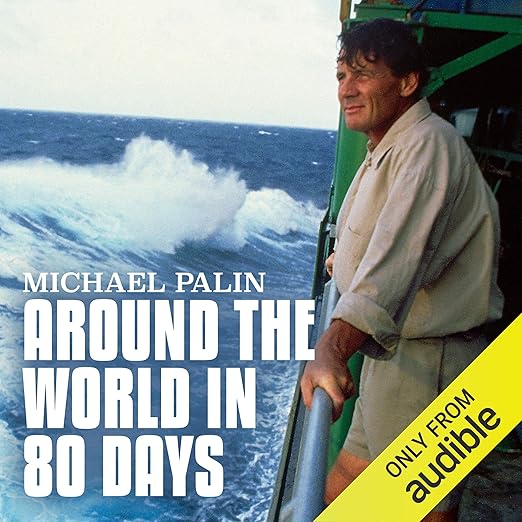
There is a particular kind of travel writing – warm, self-deprecating, genuinely curious about the world and the people in it – that Michael Palin defined almost single-handedly in the late 1980s and early 1990s. Around the World in 80 Days was the beginning of that, and hearing Palin read it himself is about as close as an audiobook experience gets to sitting across a table from the man while he tells you a very good story about something that actually happened.
What strikes me, returning to this material decades after it first aired as a television series, is how well it holds up not as nostalgia but as actual travel literature. Palin has an eye for the telling detail and a gift for summoning character in a sentence. The world he’s describing has changed enormously since 1988 – some of the countries and cities he passed through are almost unrecognisable from contemporary descriptions – and the book reads, oddly, both as a time capsule of a specific historical moment and as something essentially timeless about human curiosity and the compulsion to see what’s over the next horizon.
About the Audiobook
In the autumn of 1988, Michael Palin departed from the Reform Club in London with a plan to circumnavigate the world in eighty days, following the route taken by Jules Verne’s fictional hero Phileas Fogg 115 years earlier. The rules were straightforward and demanding: he had to make the journey in eighty days using only forms of transport that would have been available to Fogg. No aircraft. Steamships, trains, boats, camels, dhows, rubbish barges – whatever presented itself.
The journey crossed seventeen borders. Palin saw Venice from a rubbish barge, rode around the Pyramids on a camel named Michael, was attacked by a cockatoo in Hong Kong, and encountered innumerable delays, diversions, and unexpected kindnesses along the way. The television programme that documented the trip became one of the most celebrated BBC travelogues of its era; this account draws on Palin’s detailed diaries and offers considerably more texture, reflection, and interior observation than the edited television version could accommodate.
At seven and a half hours, it’s a generous but not excessive listen – the sort of audiobook that pairs beautifully with a long drive or a series of evening sessions. The prose is characteristically Palin: light, observational, free of pretension, and frequently funny in the quiet, understated way that characterises the best British travel writing. This is not the sort of book that announces its own brilliance; it simply is, quietly, very good.
For those who have read Palin’s published diaries – three substantial volumes covering his career from the Python years through the 1980s – this functions as a natural continuation in the same voice applied to one of the most ambitious journeys of his life. For those coming to his work for the first time, it is an ideal entry point that makes everything else he has written look more inviting.
The Narration
Palin reads his own work here, and the effect is immediate and distinctive. There is nobody else who could read this book and have it sound right. His timing, the slight hesitations before a particularly dry observation, the warmth that comes through even in the most exhausted or frustrated passages of the journey – none of that would survive transference to another voice. This is autobiography as performance, and Palin turns out to be a natural at it.
The Audible Studios production is clean and well-judged. There is no attempt to dramatise the text with sound effects or ambient audio – it is simply Palin, reading, and that is entirely sufficient. Some audiobooks of travel and adventure feel incomplete without production gloss; this one would only suffer from it.
What Readers Say
UK listeners have rated this 4.6 out of 5. The reviews are short but consistent: several note that the book reads as a genuine and substantial extension of his diary volumes, adding context and depth to the televised journey that viewers never received. One listener described it as “a great adventure and insight into human nature, still relevant today.” Another, who had watched the original BBC series more than thirty years ago, found that listening to the audiobook made them want to revisit it immediately. The consensus is that Palin’s voice makes this feel less like listening to a book and more like receiving a personal account from someone who simply happens to have had an extraordinary year.
Who Should Listen?
For anyone with an appetite for classic British travel writing, or for fans of the Palin BBC series who want more context, reflection, and colour than television allows. This sits comfortably alongside Pole to Pole, Sahara, Himalaya, and his other journey books – if you’ve enjoyed any of those, the rest are essential listening. The complete series of Palin’s travelogues represents some of the finest non-fiction audiobook work available in the British catalogue.
It’s also excellent for listeners who don’t usually reach for travel writing but want something companionable, intelligent, and genuinely funny for a long journey of their own. Palin makes you want to see the world, which is perhaps the highest compliment you can pay a travel writer.
Listen on Audible UK: Get Michael Palin: Around the World in 80 Days on Audible UK. Also available on Kobo, Scribd, and Storytel.