Clara’s Verdict
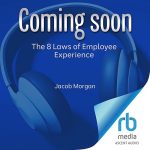
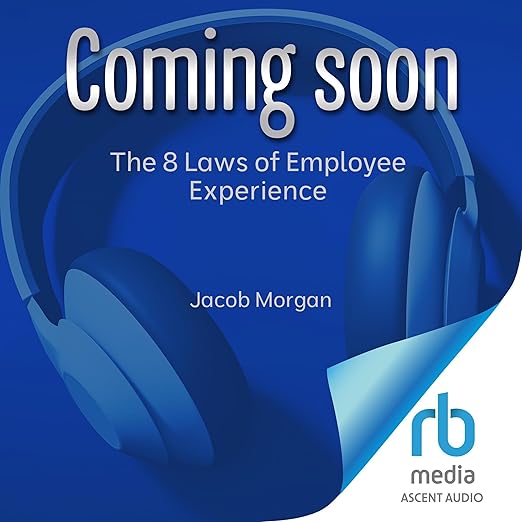
I have a mild but well-founded intolerance for business books that promise to revolutionise everything whilst telling you nothing you could not have worked out from a thoughtful article. The 8 Laws of Employee Experience is not that book. Jacob Morgan – a bestselling author and professionally trained futurist – has written something genuinely useful here, and the approach is considerably more rigorous than the genre typically manages to deliver. Drawing on over a hundred CHRO interviews at companies including Verizon, Delta, Hilton, IBM, and LVMH, this is a research-backed framework for thinking about what employees actually need from organisations in a world reshaped by AI and constant disruption. At 6 hours and 30 minutes, narrated by Rick Barr, it earns its running time.
About the Audiobook
Morgan’s central argument is that employee experience has drifted from its essential purpose: a genuine value exchange where employees contribute, grow, and lead, while organisations create real conditions for human flourishing. The book identifies eight laws that form what he calls “the new operating system for the future of work,” structured around the STEEPLE methodology for separating genuine signal from the trend-chasing noise that currently dominates the field.
What makes this more practically useful than many competing titles is the forward orientation. Morgan is not simply describing the workplace of 2025 but mapping where employee experience must go over the next decade, and providing tools for getting there. He introduces futurist frameworks – including the Cone of Possibilities for mapping multiple plausible scenarios – that give readers practical instruments for planning rather than vague exhortations to adapt. A future-ready audit concludes the book, allowing organisations to assess their current position honestly and identify where urgent work is needed. The tone is direct and uncluttered throughout: Morgan writes like someone who has actually sat in the difficult conversations he describes, and who has heard the gap between what leaders say in interviews and what their employees experience.
The book’s timing is also significant. Published as AI automation reshapes the relationship between employers and employees at a pace that most HR frameworks were not designed to handle, Morgan’s insistence on returning to fundamentals – what do employees actually need in order to contribute and grow? – cuts through an enormous amount of anxious trend-chasing. The STEEPLE methodology for evaluating trends is introduced early and applied consistently throughout, giving the book a structural coherence that many business titles lack. Each of the eight laws is illustrated with specific examples from the CHROs Morgan interviewed, which grounds the framework in recognisable organisational reality.
The Narration
Rick Barr narrates with clarity and appropriate authority. Business audiobooks can suffer when the narrator sounds as though they are reading a PowerPoint deck aloud; Barr avoids this entirely, lending the frameworks and case studies a conversational quality that makes the material feel accessible rather than academic. He handles the analytical sections with confidence and the case study passages with enough variation to maintain engagement over the full listen. The 6.5-hour runtime is well-paced: the book does not pad, and neither does Barr. A dependable and well-matched performance.
What Readers Say
Rated a perfect 5 out of 5 from early reviews. One listener called it “a must-read for any leader who wants to build a workplace that actually works for people,” praising Morgan’s ability to “cut through the fluff and deliver practical, research-backed laws that are clear, actionable, and deeply relevant in the age of AI and constant change.” The description of this as “a blueprint for building a truly future-ready organisation” rather than abstract theory reflects the book’s primary practical strength: it is consistently grounded in evidence from real organisations, aimed throughout at implementation rather than inspiration.
Who Should Listen?
CHROs, HR directors, and senior leaders thinking seriously about organisational design and the future of their workforce will get the most from this. It is also valuable for founders of growing companies who need to build HR infrastructure thoughtfully rather than reactively, and for management consultants who need a structured framework to share with clients navigating AI-driven change. The futurist methodology makes it useful beyond the immediate HR context: anyone who must think systematically about organisational change over a ten-year horizon will find the scenario-planning tools directly applicable. Listen on Audible UK: get The 8 Laws of Employee Experience on Audible UK. Those in HR consulting, organisational design, or executive coaching will find this a practically useful resource to recommend to clients and to reference in their own work. Available on Audible UK, Kobo, and Scribd. Morgan’s previous work, including The Employee Experience Advantage and The Future Leader, provides useful context for this book, and readers who have followed his thinking over time will find The 8 Laws represents a significant sharpening and updating of his framework.