Clara’s Verdict
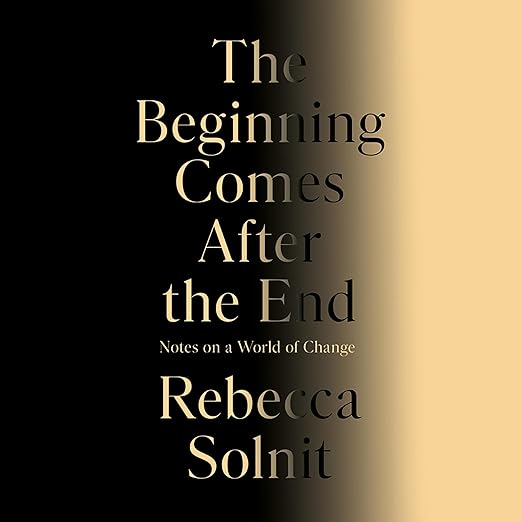
Rebecca Solnit has spent three decades making the case that paying attention to history – properly, generously, with an eye for what has changed rather than what persists – is the most sustaining form of political hope available to us. The Beginning Comes After the End, published by Granta Books and released in March 2026, is her latest attempt to hold that conviction together in a world that seems increasingly determined to test it.
I listened to Solnit read her own work on a morning that felt, in the particular way certain mornings in 2026 do, like the sort of morning that required reinforcement. She did not disappoint, though she did complicate matters in the way that the best essayists always do.
About the Audiobook
Running at five hours and narrated by the author, The Beginning Comes After the End is framed as both a retrospective and an argument: a mapping of the "extraordinary revolution in politics, thinking, and human rights" that Solnit claims we have been living through over the past fifty years, largely without recognising its scale. The book opens with a Gramsci quotation – "An old world is dying; a new world is being born; now is the time of monsters" – which sets the tone precisely. Solnit’s project is not to deny the monsters but to insist that their presence is evidence of a struggle in progress rather than proof of defeat.
Published by Granta and positioned as a culmination of years of activist thinking and writing, the book ranges across the dismantling of colonial frameworks, the evolution of environmental consciousness, movements for racial and gender justice, and the profound shifts in how we understand the relationships between human beings, between humans and nature, and between capitalism and possibility. The thematic architecture is recognisably Solnit’s – essayistic, circular, returning to the same ideas from different angles rather than building a linear argument – and it will be immediately familiar to readers of Men Explain Things to Me, Hope in the Dark, and A Paradise Built in Hell.
One critic, writing from the United States, raised a concern worth noting: that Solnit’s most recent essays feel less like fully developed books and more like "notes for a book" – collected thoughts without a strong organising centre. That is a legitimate observation, and listeners hoping for the structural rigour of her best earlier work may find the essayistic looseness of this collection less satisfying than the thesis-driven writing of a decade ago. But Solnit at her most scattered is still Solnit, and the sentences are still extraordinary.
The Narration
Solnit reads her own work with the precision of a writer who knows exactly how each sentence is intended to land, and the intimacy this generates is one of the audiobook’s genuine strengths. Her voice is measured and thoughtful, occasionally dry, and she handles the rhetorical passages – the moments where the writing reaches for something more than argument – with the restraint of someone who trusts the words not to need performing. For a five-hour listen, this is a welcome quality. There are moments where a professional narrator might bring more variation in pacing, but the authenticity of the author’s own reading more than compensates.
What Readers Say
With a rating of 4.2 from 20 Audible listeners – a small but engaged sample – The Beginning Comes After the End has received the kind of reviews Solnit’s work typically generates: intense appreciation from committed readers, qualified admiration from those who place her best work earlier in her career. One reviewer called it "the encouraging tonic that we need," placing it alongside Hope in the Dark as essential Solnit for the current moment. Brian Lewis, a self-described Solnit admirer, offered the more searching assessment: her best work is more than a decade old, and the recent essay collections, including this one, have not quite matched the ambition of A Paradise Built in Hell or River of Shadows. Both positions are defensible, and prospective listeners deserve to know that both exist.
Who Should Listen?
This is the audiobook for readers already within Solnit’s orbit who want her current thinking on where we are and where we might be going. It is particularly well suited to those who engage with progressive politics and environmental activism but find much of the discourse in that space either too apocalyptic or too shallow to be useful. New readers would benefit from starting with Hope in the Dark or Men Explain Things to Me before arriving here – those books give context that makes this one resonate more deeply. For those who find the present moment genuinely difficult to think clearly about, Solnit’s combination of historical perspective and practical optimism offers something that most political commentary does not.