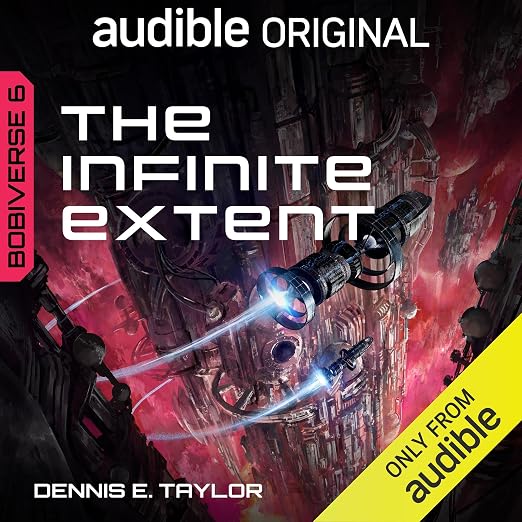
Clara’s Verdict
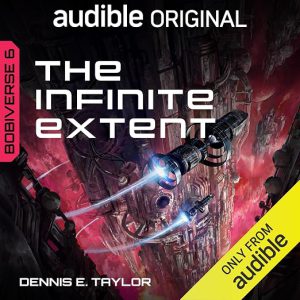
Reviewing an audiobook before anyone has rated it is an unusual position, and I want to be transparent about it from the outset. The Infinite Extent is an Audible Original arriving on 10 September 2026, and as I write there is no rating and not a single listener review attached to the listing. It has nonetheless reached the upper end of the Audible UK charts, which is a testament to how much goodwill Dennis E. Taylor and Ray Porter have banked together over this series.
What I can assess with confidence is the shape of the thing: eight hours and twenty-two minutes, a Bobiverse novel, and Porter behind the microphone. That combination has a strong history behind it, and eight hours is notably lean for this series, which suggests something tighter and more focused than the sprawling middle instalments.
About the Audiobook
The publisher has done something slightly cheeky with the description, presenting the plot as a to-do list. Determine who built a vast wormhole network and why. Investigate a mysterious derelict alien spaceship. Crack faster-than-light travel. Help tens of thousands of refugees find a new planet. Confront a new threat from an old enemy. Figure out how to save the known universe from certain destruction. Then the punchline: “So many crises, so little time. It’s really not easy being a Bob.”
That format is funnier than it has any right to be, and it is also an accurate description of how these books actually operate. The series has always run several plot threads in parallel because its premise permits it. Bob is not one person having one adventure but a proliferating set of copies pursuing separate problems across enormous distances, and the to-do list is essentially a summary of who is currently doing what.
A word on entry points. The listing does not carry series data, but the description makes the position unambiguous: an old enemy returning, a refugee population already displaced, a wormhole network already discovered. This is a continuation and it assumes you have been travelling with these characters for some time. Starting here would be like joining a long conversation at the point where everyone has stopped explaining themselves.
The Narration
Ray Porter and this series constitute one of the strongest author and narrator marriages in modern science fiction, and the reason is technical rather than sentimental. Porter excels at male protagonists with dry, self-deprecating interior voices, and Bob is close to a laboratory specimen of that type. The wit is a character trait rather than a joke delivery system, which means the comedy has to emerge from timing and understatement rather than emphasis. Porter never pushes it.
The genuinely hard problem this series sets, and I think it is unique in audio, is that most of the cast are copies of the same man. A narrator cannot differentiate them with accents, because they have no reason to have different accents. Porter’s solution is to build distinction from personality drift instead, letting each version carry slightly different appetites, irritations and rhythms of speech, so that you know which Bob is speaking from the shape of his thinking rather than the pitch of his voice. That is a considerable feat and it is why the series works better in audio than on the page.
The publisher quotes a listener line I rather enjoyed: “With Ray Porter narrating, this surge drive is firing on all cylinders.” Marketing, obviously, but the sentiment matches my own expectations closely.
What Readers Say
Here I have to be straight with you. There is no rating on this title and the review pool is empty, because the recording has not yet reached listeners. Anyone who tells you what the reception is like is guessing, and I would rather say so plainly than dress up a projection as a consensus.
What the publisher offers instead are listener quotes about the series as a whole rather than this instalment, describing it as “smart, funny and addictive”, as “a love story to science fiction” and as “my favorite series ever”. Those are real reader responses, selected by a marketing department, and they describe books that already exist rather than this one. Treat them accordingly.
In place of a listener verdict, let me offer my own reservation, which is the thing I would want flagged if I were deciding. Long-running series with a proliferating cast tend to face a structural problem eventually: the more threads that exist, the less time any one of them receives. A runtime under nine hours is a tight allocation for the six-item agenda quoted above. It could mean welcome discipline after some expansive predecessors. It could equally mean several threads receiving a nod rather than a resolution. I do not yet know which, and neither does anyone else.
Who Should Listen?
This is a continuation, not a doorway, and that determines almost everything. If you have followed Bob this far, Porter is back, the runtime is manageable, and there is no reasonable argument for stopping now. If you have not, begin at the beginning, where the premise still has the power to surprise you and nobody is confronting an old enemy you have never met.
Anyone who buys largely on ratings should simply wait a fortnight after release and let the picture assemble. There is no rush and no penalty for patience. I would also gently note that Taylor’s appeal is quite specific: engineering problems solved cheerfully by a likeable narrator with good jokes. Those who want their science fiction sombre, literary or politically weighty have never been the audience for this series, and this volume shows no sign of changing course.