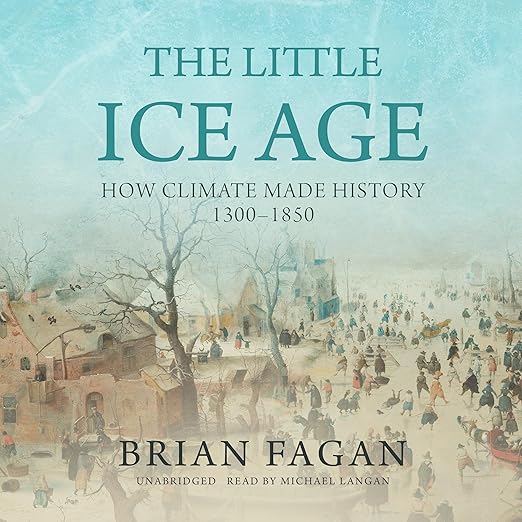
I came to The Little Ice Age having just finished a book about the Black Death, and the two turned out to be natural companions in an unexpected way. Both are stories about how forces that humans could neither predict nor control reshaped the societies they struck. Brian Fagan’s account of the 500-year cold snap that gripped Europe from roughly 1300 to 1850 is one of those rare popular history books that fundamentally changes how you read other history books. Once you have absorbed its central argument, you will find yourself asking about the weather in every subsequent medieval narrative you encounter. The climate becomes a character, present in every scene even when not mentioned.
This is climate history done without polemic, which has made it, somewhat unfortunately, a book claimed by people on almost every side of contemporary climate debates for reasons Fagan did not necessarily intend. He was writing as an archaeologist and historian in 2000, before the current political temperature around climate science had reached its current intensity. His care to present climate as a contributing factor rather than a monocause has been read by some as validation of scepticism; his detailed account of genuine historical warming and cooling cycles has been read by others as confirmation of anthropogenic change. Neither reading is quite what the book is actually doing.
Clara’s Verdict
Fagan’s method is to trace the consequences of climate variation through specific, granular historical events rather than through abstract data. The connections he draws are not speculative but structural: changing sea temperatures drive the cod southward, English and Basque fishermen follow them across the Atlantic, and European contact with the New World becomes partly a story of climate-driven migration rather than purely ideological expansion. The subsistence crises of 18th-century France – repeated harvest failures producing generational poverty and social disintegration – are linked to the persistent cold of the Little Ice Age’s final centuries, with the implication that the conditions for Revolution included a climatic component that textbook history routinely ignores.
These are not deterministic arguments. Fagan is careful throughout to acknowledge the limits of climate as explanation – he notes that the same cold affected different societies differently depending on their political structures, agricultural flexibility, and social capital. What the book does is add a dimension to familiar events that standard political and social history strips away. After reading it, you understand the Hundred Years War differently, the Norse settlement of Greenland differently, and the Industrial Revolution differently. That is a high return for an eight-hour listen.
About the Audiobook
Published by Blackstone Publishing in May 2022. Runtime of 8 hours and 32 minutes. Rating of 4.2 from 477 reviews, which is a substantial and reliable sample accumulated over years of readership. The narrator is Michael Langan. The original book was published in 2000, which means some of the climatological science has been updated or refined in subsequent research – in particular, the mechanisms of the Atlantic thermohaline circulation that Fagan discusses were subject to ongoing investigation through the 2010s. The historical argument, however, remains sound and the narrative has not aged.
The Narration
Michael Langan has a voice suited to analytical nonfiction – measured, clear, with a slight formality befitting scholarly material while remaining engaging across eight-plus hours. Fagan’s prose moves between scientific explanation and historical narrative, sometimes within the same paragraph, and Langan manages those transitions without creating jarring discontinuities. History audiobooks of this kind can become monotonous if the narrator settles into a single register; Langan maintains a slight tonal differentiation between the descriptive and expository modes that keeps the listener oriented. For a book that covers everything from Viking exploration to the French Revolution, the ability to hold pace and clarity across such varied material is a genuine skill.
What Readers Say
Reviews span from 2009 to 2016, a sustained readership rather than a publication-month spike. The consistent theme is surprise at how much the material enriches the reader’s understanding of familiar history – multiple reviews note that the book ‘changes how you think’ about events they believed they already understood. A 2009 reviewer calls it ‘a fascinating synthesis of climatology, history, sociology, and politics’. The outlier voices use the book as ammunition in contemporary climate debates, which reflects the political temperature around the topic rather than the book’s actual argument. Fagan is a historian and archaeologist writing about historical climate variation – not a participant in current policy debates, and the book should not be read as one.
Who Should Listen?
Readers of popular history with an interest in how environmental conditions shape human events. Those who enjoyed Geoffrey Parker’s Global Crisis on the 17th-century catastrophe or Steven Johnson’s work on how physical systems shape social outcomes will find Fagan a natural companion. Climate scientists seeking historical context will find the synthesis valuable, though they will want to supplement the 2000 science with more recent research on ocean circulation and ice-core dating. Not recommended as a primary text for current climate policy arguments on either side – Fagan’s concern is historical understanding, not present-day advocacy.