Clara’s Verdict
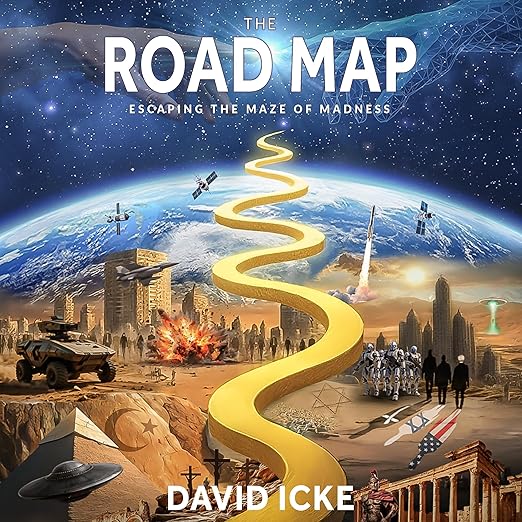
David Icke requires a particular kind of framing, and I want to be direct about it before we proceed to anything else. The Road Map: Escaping the Maze of Madness is a thirty-one-hour audiobook – the longest in this batch by a considerable margin – presenting what its author describes as the product of decades of full-time research into what he characterises as a conspiracy for human control operating at an interdimensional level. Icke has been a prominent and consistently controversial figure in the global conspiracy theory ecosystem since the early 1990s, and his work encompasses a wide range of claims – from legitimate scepticism about media concentration and institutional power to assertions that have been widely condemned as antisemitic by scholars, broadcast regulators, and civil society organisations in multiple countries, including the UK.
I am reviewing this book because it appears in the Audible UK catalogue and because readers deserve honest engagement with the content they’re being offered, not a refusal to acknowledge its existence. But intellectual honesty requires transparency: this is not a work of history, journalism, or empirical research. It presents a totalising conspiratorial worldview, and that is the appropriate framework through which to evaluate it honestly.
About the Audiobook
The book positions itself as a massive expansion and update of Icke’s 1998 work The Biggest Secret, described here as the Rosetta Stone of conspiracy research – a claim about its own significance that tells you something about the register in which it operates. The themes are characteristic of Icke’s extensive back catalogue: global elites manipulating events across centuries, hidden forces shaping political and cultural reality, the manipulation of human consciousness through media and educational institutions, and a metaphysical framework that blends New Age spirituality with political grievance and apocalyptic revelation. The interdimensional element of the conspiratorial panorama is specific to Icke’s version of these narratives and does not appear in most other contemporary conspiracy traditions.
At thirty-one hours and forty minutes, this is a substantial listening commitment by any measure. Long-standing readers of Icke, as one reviewer accurately notes, are unlikely to find a great deal of genuinely new material here – the book draws extensively on his previous works and refers listeners back to them for more detailed treatment of subjects it can only allude to in passing. It functions primarily as a synthesis and comprehensive summation of a worldview for existing followers rather than as an introduction for newcomers who haven’t encountered his work before.
The Narration
Icke narrates his own work, as he typically does, and for the existing audience this is a significant asset. Self-narration brings an authenticity and conviction to material of this kind that a professional actor reading the script could not replicate – Icke’s voice carries the weight of someone who genuinely believes every word, which is either the most compelling or the most unsettling quality of the performance depending entirely on your perspective and what you bring to the listening. He reads with the cadences of a practised public speaker and maintains that quality across thirty-one hours, which is no small feat of physical endurance regardless of what one thinks of the content being delivered.
What Readers Say
The book carries a 4.5-star average from 192 ratings on Audible UK, a strong result that reflects an engaged and loyal existing readership rather than broad general appeal. Reviewer Arrian, identifying as a long-standing reader, called it impeccably researched and suggested it would be the ideal starting point for newcomers despite its considerable length. Reviewer Lynn offered a more nuanced response: expressing uncertainty about claims derived from remote viewing, discomfort with Icke’s treatment of Christianity, while also finding a lot to ponder and considering the sections on dark forces credible. This kind of thoughtful internal critique – agreeing with some claims, questioning others – appears periodically in reviews from within the Icke readership.
Who Should Listen?
The Road Map will find its natural audience among existing followers of Icke’s work who want a comprehensive synthesis of his worldview in a single extended listening experience. It is not recommended as an introduction to critical thinking about institutional power, media ownership, or political economy – more rigorous, better evidenced, and more intellectually honest guides exist in abundance in all of those areas. Listeners new to Icke should be aware that this material sits entirely outside the mainstream of historical, political, or scientific analysis, and that specific claims within it have been seriously disputed, refuted, or condemned by mainstream authorities. Approach with independent scepticism and a willingness to verify sources for yourself rather than accepting the author’s claims at face value.
Whatever conclusions a listener reaches about the validity of Icke’s claims, thirty-one hours is an exceptional amount of audio content, and the production quality is consistent throughout. The book is a complete and internally coherent statement of a worldview, and for those who share that worldview or are genuinely curious about its full architecture, it delivers exactly what it promises.