Clara’s Verdict
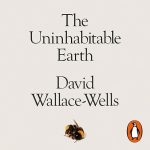
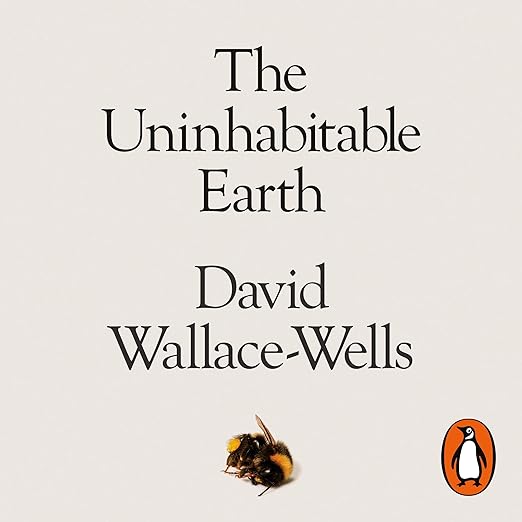
I listened to the opening chapter of The Uninhabitable Earth on a January evening after a day of reading IPCC summaries for a piece I was writing, and I had to stop and sit with it for a moment. David Wallace-Wells opens not with statistics but with a flat declarative statement — it is worse, much worse, than you think — and then proceeds to make good on that claim with a methodical, almost forensic accumulation of what our warming planet is already doing and what it will do within the lifetimes of people already alive. It is one of the more genuinely unsettling books I have encountered in years, and I mean that as a qualified recommendation, not a deterrent.
The slowness of climate change is a fairy tale, Wallace-Wells writes early on, perhaps as pernicious as the idea that it isn’t happening at all. That line has stayed with me. This is journalism at its most ambitious: a book that takes the scale of a civilisational crisis seriously and refuses to domesticate it into a tidier narrative than the facts permit.
The Architecture of Crisis
Published by Penguin in February 2019 and running eight hours and thirty-three minutes, The Uninhabitable Earth is Wallace-Wells’s expansion of his viral 2017 New York Magazine article of the same name — an article that generated more reader responses than any the magazine had published to that point. The book moves through what he calls the elements of chaos: heat death, hunger, drowning, wildfire, freshwater scarcity, dying oceans, unbreathable air. Each chapter takes one thread of consequence and follows it to its logical and scientific end, building a cumulative picture that is considerably more alarming than any single headline.
After cataloguing the cascading physical consequences, Wallace-Wells pulls back to consider the larger systemic and psychological dimensions: how capitalism’s short-termism, how narrative structure itself, and how the human cognitive tendency to discount future pain all conspire to make us persistently underreact to what is happening in plain sight. This second half of the book is in some ways more interesting than the first, because it asks not just what is happening but why we are so constitutionally ill-equipped to respond to it.
The early chapters are deliberately harrowing, and Wallace-Wells is not interested in softening the science for palatability. The later sections, however, pivot towards questions of human response and the conditions under which collective action becomes possible — not quite hopeful, but refusing pure despair. That movement from darkness towards something more analytical is important: this is not a doom-scroll in book form, even if it sometimes reads that way in the first act.
Several reviewers note that the book arrived before a number of major climate events of the past six years, which means some of its possible-future framings have already become historical record. That fact makes the 2019 text feel, if anything, underscaled — a thought Wallace-Wells himself has acknowledged since publication.
The Author’s Own Voice
Wallace-Wells reads his own book, and self-narration proves exactly right here. He writes in a voice that is at once authoritative and anxious — a journalist who knows too much and can’t quite reconcile that knowledge with ordinary daily existence — and that registers in his reading. He doesn’t perform anguish; he speaks with the measured urgency of someone who has spent years researching this subject and finds the distance between public discourse and scientific reality genuinely alarming. The prose is dense at points, and his delivery keeps pace with the intellectual texture of the writing without feeling rushed or impatient.
What Readers Say
Audible UK listeners gave this 4.4 stars from four ratings, which undersells the book’s reputation considerably — this is a title that has sold broadly and generated sustained conversation since publication. The written reviews range from evangelical to measured. Deep Reader, reviewing in October 2025, called it an exceptional gathering of just about every aspect of the climate crisis with a realism not previously encountered. A reviewer named Crumbledore gave four stars and described it as absolutely terrifying but essential reading — dense and overwhelming at times, but deliberately so, with the real power lying in forcing the reader to confront the facts directly. A February 2020 review from Mr R Timms recommended persevering through the dark early chapters, noting that the best comes later: the hope, the optimism, and the practical questions. One three-star reviewer acknowledged the content’s importance but found it difficult to engage with throughout — a valid response to material this concentrated, and one that Wallace-Wells would probably accept as a reasonable outcome.
Who Should Listen?
Essential for anyone who wants to move beyond headline-level climate literacy into a serious reckoning with what the science actually shows. Particularly useful for parents, educators, and anyone working in policy, business, or media who needs to understand the stakes rather than the talking points. Those wanting comfort or easy answers should be warned that this book offers neither, and that is not a criticism. If you need to work through the dark first chapters, know that the later analytical sections offer more light. At eight and a half hours, it is a significant commitment — but the subject probably warrants it. Listen on Audible UK