Clara’s Verdict
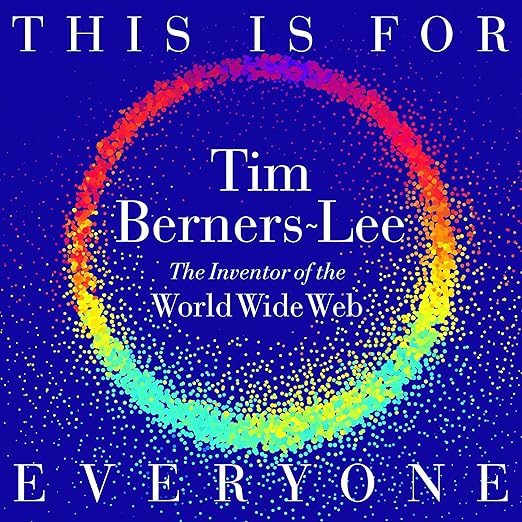
When Stephen Fry describes Tim Berners-Lee as “the greatest living Englishman,” and then proceeds to narrate his memoir, the result is either a conflict of interest or an act of perfect casting. I’d argue strongly for the latter. This Is for Everyone is Berners-Lee’s account of inventing the World Wide Web, giving it away without commercial reward, and living with the consequences of both decisions – the extraordinary flourishing of creativity and connection that followed, and the darker trajectory of surveillance capitalism, algorithmic manipulation, and democratic erosion that has followed it. Fry’s narration is ideally suited to every register in the book. With 203 ratings averaging 4.5 stars, this is among the essential non-fiction listens of its year.
About the Audiobook
Berners-Lee invented the World Wide Web in 1989 at CERN and made a decision that seems more extraordinary the longer you contemplate it: he did not patent it. He shared it. No commercial exploitation, no licensing fee, no negotiation – just a protocol made available to anyone with a computer and a connection to use as they saw fit. The consequences of that act of intellectual generosity have been more profound than perhaps any comparable decision in modern history, and this memoir grapples with all of it with characteristic honesty and care.
The book spans Berners-Lee’s upbringing – both his parents worked on the Manchester Mark 1, one of the world’s earliest computers, a fact that gives the whole narrative a pleasing hereditary quality – through his years as a student and early programmer, the pivotal period at CERN where the Web was conceived, the remarkable moment of release, and the decades since spent working to address the unintended consequences of what he created. The World Wide Web Foundation and the Solid project – his current effort to give individuals back control of their personal data – are explained with the same clarity and optimism that characterises the whole book.
What distinguishes this memoir from the numerous tech biographies that have populated the market in recent years is Berners-Lee’s refusal to be either triumphalist or defeatist. He is optimistic by temperament – this quality is evident throughout – but clear-eyed about the scale of the problems. His diagnosis of what went wrong – the commercial race to monetise attention through advertising, which colonised the Web’s architecture in ways that have had profound effects on public discourse and individual psychology – is precise and persuasive without being simplistic. He is not naive about what he set in motion; he is honest about it, and that honesty is what gives the book its authority.
The audiobook includes a prologue read by Berners-Lee himself and a bonus conversation between him and Fry – both additions that make the format particularly valuable. The conversation is genuinely worth the time: two intelligent, complementary minds engaging with questions about the Web’s future in ways that are both substantive and accessible.
The Narration
Fry narrating Berners-Lee’s memoir is one of those casting decisions that becomes self-evidently right the moment you hear it. His voice carries the intellectual warmth and light comedy the prose demands – Berners-Lee writes with genuine wit alongside the technical precision – and he handles the more technical passages with clarity and evident enjoyment rather than the slight reluctance that sometimes marks a literary narrator encountering technical material. The bonus conversation between Fry and Berners-Lee, included in this edition, is particularly worth the time: the two men have a genuine rapport, and the discussion of what comes next for the Web is among the more interesting technology conversations available in any format.
What Readers Say
UK reviewers have been very positive, with a 4.5 rating across 203 reviews. One listener described it as “essential knowledge for the 21st century,” noting multiple “aha moments” for readers who grew up with the internet without understanding its origins or architecture. Another found it “captivating from Chapter 1.” A more nuanced review acknowledged the technical density of certain sections while noting they can be navigated around by listeners who want the personal narrative – fair advice that also works in reverse. An IT professional who has spent decades managing websites called Berners-Lee’s critique of big tech “balanced and spot on,” noting the memoir’s “plenty of lessons for us all.” The consistent thread across reviews is admiration for Berners-Lee’s humility in describing one of history’s most consequential inventions.
Who Should Listen?
Essential listening for anyone who uses the internet, which is to say: everyone. Particularly valuable for listeners interested in the history of technology, the political economy of digital platforms, or the questions about what a better, more humane internet might look like. Also excellent for those who came to technology later in life and want to understand how the tools that shape daily life actually came to be. If you’ve enjoyed tech biographies by Walter Isaacson or Ashlee Vance, this offers a very different perspective on the same era – humbler, more ethically serious, and considerably more worried about what comes next. Essential company for any train journey long enough to let you think.
Listen on Audible UK: Get This Is for Everyone on Audible UK. Also available on Kobo, Scribd, and Storytel.