Clara’s Verdict
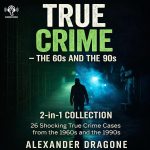
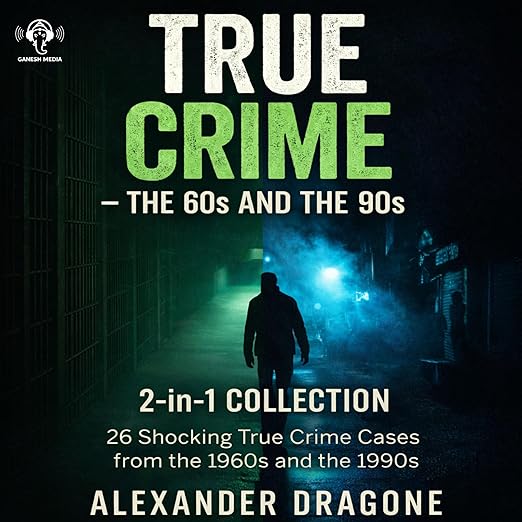
True crime collections live or die by the quality of their editorial selection and the depth of analysis they bring to the cases involved. True Crime: The 60s and the 90s by Alexander Dragone is a more focused effort than many in this increasingly crowded genre – the dual-decade framing gives it structural coherence, and the emphasis on investigative process rather than shock value lifts it above the merely sensationalist. Patrick Shannon’s narration is composed and clear, appropriate for material that demands a sober register. With over four hours of content across twenty-six cases, this is a solid introduction to the criminal psychology of two defining American decades.
About the Audiobook
The collection is structured as two distinct halves, each addressing its era’s particular cultural context. The 1960s section situates its cases against the backdrop of civil rights protests, suburban aspiration, and the fractures beginning to show in postwar American optimism. The cases examined include the Zodiac Killer – whose combination of calculated provocation and operational anonymity remains genuinely disquieting – alongside domestic crimes that, Dragone argues, were symptomatic of the era’s hidden pressures. The juxtaposition of idealism and violence is handled thoughtfully rather than crudely.
The 1990s section shifts register: forensic science has advanced, the 24-hour news cycle has transformed the relationship between crime and public attention, and the cases themselves often involve what Dragone terms the rise of the “calculating lone-wolf killer.” The coverage of landmark trials and the role of media attention in shaping both prosecution and public perception is particularly well-handled. The investigative breakdowns section – examining both bungled investigations and forensic game-changers – is the most analytically ambitious portion of the book, and the most rewarding.
At four hours and twenty-three minutes, this is a compact listen. Some cases receive only brief treatment, and readers wanting extended deep dives into individual crimes should seek out more specialised titles. As a survey of two decades and their criminal pathologies, however, it is well-constructed and genuinely informative.
The Narration
Patrick Shannon delivers a measured, authoritative performance suited to the material. True crime narration faces a specific challenge: remaining engaged enough to maintain listener interest without tipping into performative relish of the subject matter. Shannon maintains the right balance throughout. His pacing is controlled, his enunciation clear, and his transitions between cases handled cleanly. This is professional, unshowy narration, which is exactly what a collection of this kind requires.
What Readers Say
This is a new release from March 2026, and listener reviews are still accumulating. The book’s appeal is evident from its positioning: readers drawn to comparative true crime – cases examined across different eras and investigative contexts – will find the dual-decade structure particularly engaging. The emphasis on psychology and investigative process rather than pure chronology distinguishes it from more formulaic collections. For those approaching the genre for the first time, the book’s self-described aim to go “beyond the headlines” into the human stories behind the cases makes it a considered starting point.
Who Should Listen?
Ideal for listeners with an interest in criminal psychology, investigative history, and the cultural context of crime – particularly those curious about how American society in the 1960s and 1990s shaped the crimes that defined each era. Suitable for both seasoned true crime listeners and newcomers. At under five hours, it makes an excellent commute companion or a single long evening’s listening.