Clara’s Verdict
Liam Byrne published Why Populists Are Winning in March 2026, two years into a political landscape that had already delivered Trump’s return to the White House, a surge for Marine Le Pen in France, and Reform UK’s emergence as Britain’s most electorally significant far-right force in modern history. The timing gives the book an urgency that Byrne, a former Labour minister and current MP for Birmingham Hodge Hill, is well-placed to exploit. He has watched the populist wave from inside the democratic institutions it threatens, and that proximity gives his analysis texture that purely academic accounts often lack.
The question I brought to this listen was whether Byrne had anything genuinely new to say, or whether this was primarily a well-timed repackaging of arguments that Cas Mudde, John Judis, and others have been making for years. The answer is: mostly new enough to justify the five hours, particularly the original polling data and the anatomy of populism’s five distinct voter tribes.
About the Audiobook
Byrne’s structure is ambitious. He moves from on-the-ground reporting in inner-city Birmingham to the trading floors of Wall Street to the Heritage Foundation in Washington, tracing the financial and institutional infrastructure that sustains the populist project. The section on Britain’s populist media-political complex, covering the networks of funding, amplification, and outrage machinery that link Reform UK to its transatlantic counterparts, is forensic and, at moments, startling.
The five-tribe model that Byrne introduces as an analytical framework is the book’s most useful contribution. Rather than treating populist voters as a monolithic bloc, he distinguishes between those driven by economic grievance, cultural anxiety, anti-establishment fury, nostalgia, and what he calls democratic disillusionment. Each tribe requires a different political response, and the second half of the book is devoted to sketching what those responses might look like in practice. This is where Why Populists Are Winning becomes something more than a diagnosis.
The rhetoric analysis chapter, examining how populists weaponise fear and nostalgia, draws on Byrne’s original polling data and is convincingly argued. His warning that democracies tend to fall not in normal times but after the next crisis, when hope collapses, is the book’s sharpest formulation and the one most likely to stay with listeners long after the final chapter. The book is described by Andrew Marr in the New Statesman as required reading, and that endorsement feels proportionate to what Byrne has produced.
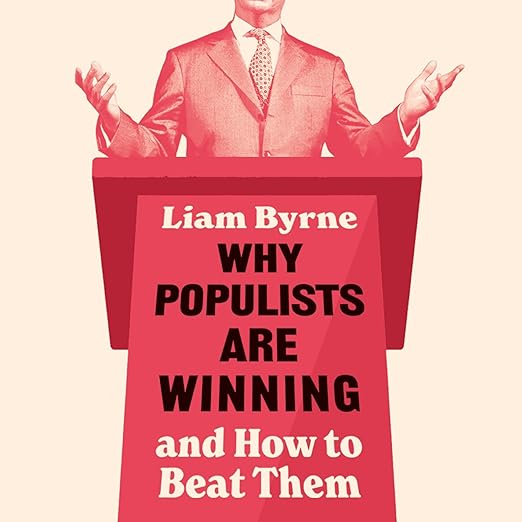
Andrew Marr’s endorsement from the New Statesman appears on the cover, and it is not the kind of compliment that can be dismissed as mere back-scratch. Byrne is writing about a moment of genuine democratic peril with the authority of someone who has spent his career trying to prevent it.
The Narration
Byrne reads his own book, and this is one of those cases where self-narration is an asset rather than an indulgence. He speaks with the cadence of someone who has delivered this argument from a platform, and the parliamentary diction lends authority without stiffness. The reporting sections, where he is describing what he witnessed in Birmingham or Washington, come alive in his own voice in a way they might not have with a professional reader. There is an audible urgency in the way he phrases his central warnings that a third party would have found harder to replicate convincingly.
What Readers Say
Why Populists Are Winning carries a three-star rating from a single UK reviewer at the time of writing, reflecting a very small sample rather than a settled verdict. Martin Southard, reviewing on the day of release, called it “an accessible and timely look at the rise of populism, written in a way that’s easy to follow without feeling too academic.” He appreciated its attempt to go beyond diagnosis and offer practical ideas for mainstream political renewal. A single review cannot be treated as representative, and the book’s very recent publication date means the audience is still forming its response. The rating will shift as more readers arrive.
Who Should Listen?
Essential listening for anyone trying to understand why mainstream centre-left and centre-right politics has been losing ground across the Western world, and what, if anything, can be done about it. Particularly relevant for UK listeners watching the rise of Reform UK, and for those who want analysis grounded in original data rather than commentary. Readers of Timothy Snyder’s On Tyranny or Fintan O’Toole’s Heroic Failure will find this a worthwhile companion. Those seeking ideological comfort will find Byrne’s conclusions challenging from multiple directions, which is precisely the point.