Clara’s Verdict
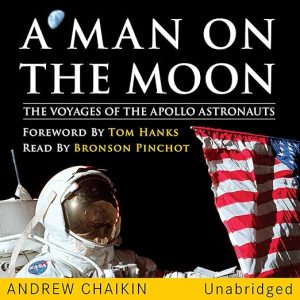
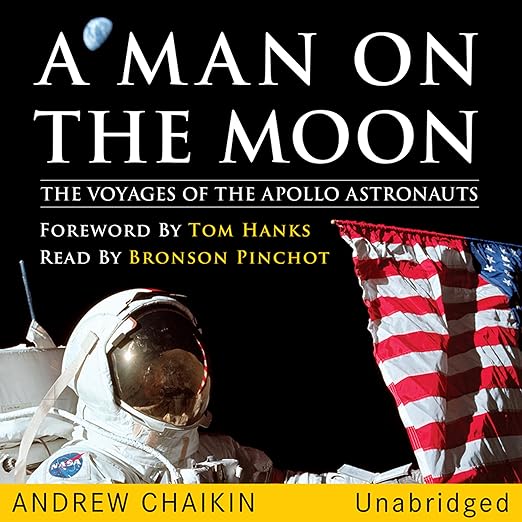
Andrew Chaikin’s A Man on the Moon has been the definitive account of the Apollo programme since its original publication, and the astronauts themselves have called it exactly that. The Audie Award for History/Biography in 2016 was well earned. At twenty-three hours narrated by Bronson Pinchot, this is a substantial undertaking – but it is the kind of undertaking you commit to and do not regret. Pinchot’s narration is one of the finest performances in non-fiction audio, and Chaikin’s research – drawn from in-depth interviews with twenty-three of the twenty-four moon voyagers – is simply without parallel. This is what history sounds like when it is done properly.
About the audiobook
Chaikin’s method is intimate and meticulous. Rather than constructing a broad institutional history of NASA, he follows the individual experiences of the men who flew to the moon – their training, their fears, their moments of transcendence at 240,000 miles from home, and the complicated emotional aftermath of having done something that no human being had ever done before. The result is a portrait of heroism that is neither hagiographic nor reductive: these are men under extraordinary pressure, making real decisions with inadequate information, and their fallibility only deepens the achievement.
The book covers the full arc of the Apollo programme from the early missions through the triumphant Apollo 11 landing on 20 July 1969 – when Neil Armstrong and Buzz Aldrin walked on the moon and our world changed forever – to the later missions that attracted diminishing public attention despite their considerable scientific achievement. One reviewer on Audible UK noted that, like in real life, interest can begin to wane after the moon landing itself; Chaikin acknowledges the difficulty of following the impossible, and his account of the final missions carries a melancholy that the earlier chapters do not.
The narration
Bronson Pinchot’s narration is the ideal vehicle for this material. He has both the gravity to honour the historical weight of the events and the range to capture the individual voices and personalities that Chaikin spent years recording. Twenty-three hours is a long time to spend with a narrator, and Pinchot makes every one of them count. The production by Novel Audio, released in 2015, remains a benchmark for long-form history audiobooks.
What readers say
The audiobook holds a rating of 4.6 from its listeners. Jose Alberto Segura Maeso described it as the main reference for anyone interested in the Apollo history, noting that Chaikin “faces the huge amount of information and facts related with Apollo in a unique way.” Andy Blanche called it “a really richly researched account of the lunar missions” with “many revelations.” The reviewer known as The Pharmer called it “my favourite one on the Apollo programme” and praised it as unbelievable value. Michael Johnson praised the comprehensive detail: “no detail has been missed.”
Who should listen?
This is the essential Apollo audiobook – the one to listen to if you are going to listen to one. It is for anyone with an interest in space exploration, in human courage under extreme pressure, or in the history of the twentieth century’s most audacious technological achievement. It is not a light listen – it demands attention and rewards it handsomely – but it is the kind of audiobook that changes your sense of what human beings are capable of. Highly recommended for listeners who enjoy narrative non-fiction and want something that will stay with them long after the final hour concludes.