Clara’s Verdict
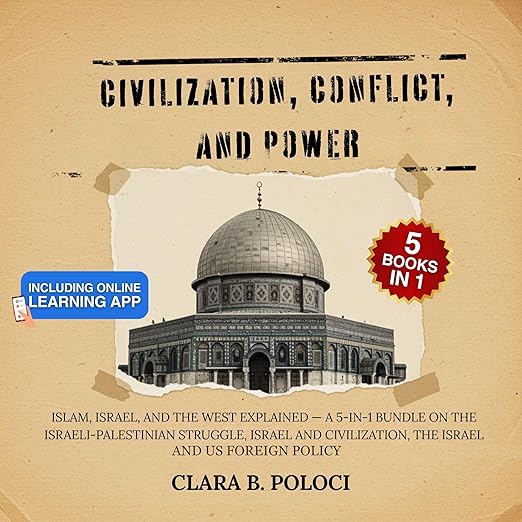
Books about the Israeli-Palestinian conflict occupy a peculiar publishing category: there are far more of them than most readers can usefully absorb, and the range from careful historical scholarship to advocacy dressed as analysis is wider than in almost any other contemporary political subject. Civilization, Conflict, and Power is a self-published guide that positions itself as a balanced alternative to one-sided coverage, organising the subject into 32 scholarly chapters across six parts. The framing is ambitious for a 4-and-a-half-hour audiobook. Whether the execution matches the ambition is the question a prospective listener needs to consider carefully before committing.
The synopsis presents the material as equidistant between perspectives: Israeli security concerns, Palestinian dispossession, and American interests are listed as parallel threads to be examined with equal rigour. This is a structural choice that carries its own assumptions about what balance means in a conflict with deeply asymmetric power dynamics and a contested historical record. Any reader approaching this as a neutral entry point should be aware that the framing of balance is itself a perspective, and one that more specialist scholarship tends to interrogate rather than accept as a starting premise.
About the Audiobook
Published in March 2026 by Clara B. Poloci and narrated by Kevin Wagner, this runs 4 hours and 34 minutes with no Audible ratings at the time of writing. The self-published format and the density of its claimed scope, 32 chapters across six comprehensive parts in under five hours, raise reasonable questions about the depth of treatment each subject receives. At roughly nine minutes per chapter on average, this is necessarily a survey orientation rather than a sustained analysis. Zionism, Palestinian identity, US strategy, Hamas, Fatah, the Israel lobby, political violence, and the question of antisemitism versus criticism: each of these subjects has extensive dedicated scholarship that has taken decades to develop.
The book presents itself as addressing a frustration with one-sided coverage, which is a real and legitimate frustration. The question for prospective listeners is whether a self-published primer with no external editorial oversight is the right vehicle for delivering on that promise. The most trustworthy guides to this subject tend to be those that have been subjected to peer review, editorial challenge, and open critical response over time.
The question of the Israel lobby, covered in one of the guide’s chapters, is perhaps the most sensitive area in the subject and also the one where a short chapter risks the most distortion. This is territory that has generated serious academic dispute between scholars such as John Mearsheimer and Stephen Walt on one side and their many critics on the other. A nine-minute chapter on this subject can introduce the debate but cannot represent it adequately. That is not a criticism of this guide specifically but a structural limitation of the format as applied to material this contested.
The Narration
Kevin Wagner provides a competent, professional read for analytical non-fiction. His voice is clear and appropriately measured for material that requires the listener to absorb argument and information rather than narrative. For politically sensitive content, a neutral, uninfluenced delivery is the right approach, and Wagner provides it. There is no available listener review feedback to draw on for this specific title, and the narration can only be assessed on the general quality of the delivery rather than on community consensus about how well it serves the material.
What Readers Say
There are no Audible reviews available for this title. It was published in March 2026 and has not accumulated listener feedback. For a topic as contested and carefully watched as the Israeli-Palestinian conflict, the absence of reviews means prospective listeners are making a decision without any community signal about whether the balance the book claims to provide holds up under scrutiny from readers who approach the subject from different positions. That signal, when it arrives, will be a meaningful part of assessing this guide’s actual quality.
Listeners curious about this subject who find the short-chapter format useful as a first orientation might also consider pairing it with a single longer, more rigorous work rather than treating this guide as the foundation. Starting with one clear perspective from a credentialed historian, reading or listening to a counter-perspective from a different credentialed historian, and using a primer like this as a map of the terrain between them is a more reliable path to genuine understanding than any single balanced guide can provide on its own.
Who Should Listen?
This may serve as a starting framework for someone approaching the subject with genuinely no prior knowledge who wants a broad orientation before engaging with more rigorous sources. The absence of reviews makes it impossible to assess how well the balance claim is maintained in practice across the full 32 chapters. Listeners with any prior engagement with the subject are better served by established works: Rashid Khalidi’s The Hundred Years’ War on Palestine, Benny Morris’s Righteous Victims, or Bernard Lewis’s The Middle East offer very different but thoroughly reviewed positions from recognised historians. The self-published format and the very short average chapter length are flags that the depth may not match the scope of the promise.