Clara’s Verdict
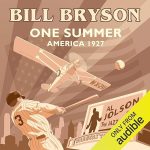
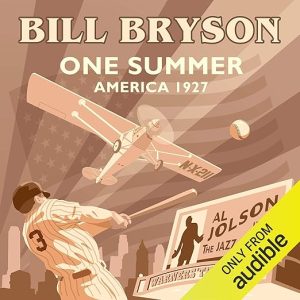
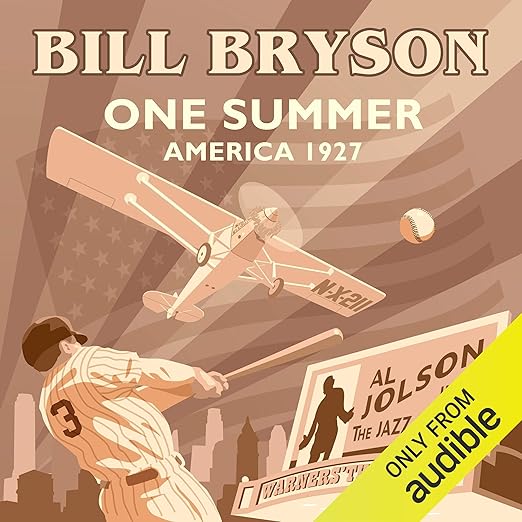
Bill Bryson narrating his own books is one of the reliable pleasures of the audiobook world. There is something about hearing him deliver his own dry, precise comedy – the timing is his, the emphasis is his, the affection for the material is obviously and entirely genuine – that print cannot replicate. One Summer: America 1927 is among his most focused and most satisfying books: a portrait of a single extraordinary summer through the gallery of people who were making history during it, told with the storyteller’s gift for finding the human detail inside the large event. Rated 4.4 from nine Audible UK listeners, it has found its audience without fanfare. At seventeen hours it is a proper commitment, and it rewards every single one of them.
About the Audiobook
The summer of 1927 was, as Bryson makes compellingly clear, a moment when America was simultaneously at its most exhilarating and most precarious – full of possibility and full of hidden catastrophe. Charles Lindbergh crossed the Atlantic alone in thirty-three and a half hours and became, in a single flight, the most famous man on Earth. Babe Ruth was having the greatest individual season in baseball history while his body was quietly beginning the long process of betraying him. President Coolidge famously worked four hours a day and allowed the decisions made in his administration to lay the groundwork for the Great Depression two years later. Al Capone ran Chicago with such casual, visible brutality that the newspapers covered him like a celebrity. A sculptor named Gutzon Borglum was beginning to blast presidential faces into the granite of Mount Rushmore.
Bryson moves between these figures – and many others – with the light-footed brilliance of a writer who has spent his entire career finding the surprising, overlooked, and genuinely funny inside the historical record. He is particularly good on the gap between how history records a moment and how it was actually experienced by the people living it: the anxiety behind the triumphalism, the chaos beneath the achievement, the contingency of events that later seem inevitable.
The research is impeccable and the prose carries it effortlessly across seventeen hours. Bryson’s characteristic generosity towards his subjects – even the appalling ones – makes the book a pleasure rather than a lecture.
The Narration
Bryson reads his own book, as he has done for most of his titles, and this is always the correct choice. His voice is warm, slightly bemused, and unmistakably mid-Atlantic – the product of an American childhood and a British adulthood of forty-odd years – which suits perfectly a book about America written from an affectionate and clear-eyed distance. His comic timing is faultless: he knows exactly how long to let a punchline breathe, and when not to signal it at all and simply let it land. The seventeen-hour runtime is no burden in his company; if anything, reaching the final chapter feels slightly too soon. Bryson is the rare writer who is actually funnier read aloud than read in silence.
There is also a secondary pleasure in this audiobook for UK listeners: Bryson has lived in Britain for decades and brings a perspective on America that is both intimate and genuinely external. He loves the country he is writing about and is not uncritical of it, which gives the book an honesty about the 1920s – with all their exhilaration and their ugliness – that a purely admiring account could not achieve.
What Readers Say
Rated 4.4 from nine Audible UK listeners. One reviewer described Bryson taking us to “the USA of a hundred years ago” through “an unforgettable cast of personalities” with “thorough research” and high entertainment. Another noted relying on Bryson to provide “an informative, entertaining and rewarding read” every time, and found all three elements present here. A reviewer from France noted that the heavy focus on American sporting figures – Babe Ruth, Jack Dempsey, Lou Gehrig – was less immediately gripping for a European audience without context for those names, though they still found the book very entertaining overall. This is a fair and honest caveat: the sports sections are detailed, and some background knowledge of 1920s American baseball makes them considerably richer.
Who Should Listen?
For anyone who loves American history, or who enjoys narrative non-fiction that wears its considerable learning lightly and with evident pleasure. Existing Bryson readers need no persuasion here – One Summer sits comfortably alongside At Home and A Short History of Nearly Everything as one of his finest and most focussed works. Listeners who enjoy Erik Larson’s approach to historical reconstruction through vivid character will find strong common ground. The audiobook format, with Bryson narrating in his own voice, is genuinely the optimal way to experience this particular book. Plan for a long weekend of listening, or the kind of commute-and-walk routine that makes seventeen hours pass without any sense of effort.