Clara’s Verdict
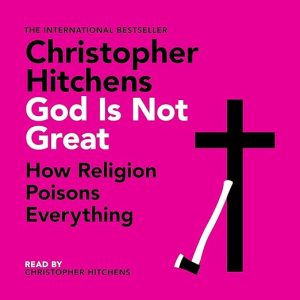
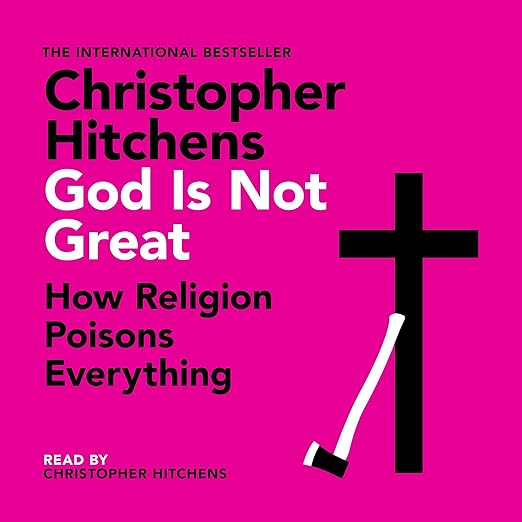
Christopher Hitchens narrating his own work is one of the great audiobook experiences – not because he is a trained actor or a particularly polished reader, but because the prose and the voice are completely continuous with each other. There is no gap between the text and its delivery. When Hitchens writes “religion poisons everything” and then reads those words aloud in the measured, slightly weary tone of a man who has made this case many times and finds it both necessary and exhausting, the effect is genuinely different from any version read by a professional narrator, however skilled.
God Is Not Great remains, more than fifteen years after its original publication, one of the most cogent and comprehensive critiques of organised religion available in audio form. At just under nine hours, it is an extended argument rather than a quick provocation, and it deserves the attention it asks for.
About the Audiobook
Hitchens’s subtitle – “How Religion Poisons Everything” – is the thesis, but the book itself is considerably more nuanced than that framing suggests. He works through Christianity, Islam, Judaism, and Eastern religions with specific historical and textual evidence, documenting the ways in which organised religion has been used to justify violence, suppress scientific inquiry, distort sexuality, and retard moral progress across centuries and cultures. He draws on an extraordinary range of references – from Voltaire and Jefferson to Salman Rushdie and Primo Levi – and his erudition is always in service of the argument rather than on parade for its own sake.
The book was written in deliberate conversation with Bertrand Russell’s Why I Am Not a Christian and Sam Harris’s The End of Faith, and it sits comfortably alongside both while being distinctly its own thing. Hitchens’s prose has a warmth and irreverence that Russell lacked, and a literary richness that Harris doesn’t quite attempt. His personal anecdotes – encounters with religious figures, experiences in places where religion and power collide – give the argument a grounded, specific quality that purely academic treatments of the subject often lack.
The final chapters, which argue for a secular humanism grounded in scientific understanding and genuine moral reason, are particularly interesting. Hitchens is as interested in what should replace religion as in dismantling religion itself, and his vision of a secular future is humane and considered rather than merely combative.
The book’s longevity – it was published in 2007 and remains in print and in active circulation – speaks to the quality of the argument rather than simply its controversy. Subsequent events in global politics have given some of Hitchens’s observations an uncomfortable prescience, particularly his chapters on the relationship between religion and political violence. He could not have anticipated the specific events that followed publication, but the frameworks he provides remain useful.
The Narration
Hitchens reads with the slightly combative confidence of a man who knows he is right and is mildly amused by the idea that anyone might disagree. His cadences are those of the lecture hall and the debating chamber – extended sentences built to a rhetorical conclusion, digressions acknowledged and controlled, questions left open just long enough for the point to land. He stumbles occasionally on a word or rushes a transition, but these minor imperfections only confirm the sense that you are in the room with him rather than listening to a polished performance. It is, in its own way, irreplaceable – and it will not be available for ever.
What Readers Say
UK listeners rate this at 4.6 out of 5 from nine reviews, with international reviews contributing further to its reputation. One reviewer described Hitchens’s style as “easy and relaxed and to the point” – a noteworthy observation given that he is writing on a subject that typically generates either defensiveness or earnestness. Another called it “an utterly insatiable and total demolition of the theory of god,” specifically praising the approach through the testimony of the faithful rather than from a detached academic distance. A third noted the distinction between the title’s bluntness and the subtitle’s precision, arguing that the subtitle provides the more accurate description of what the book actually does – which is less a denial of God’s existence than a detailed account of what religion, as a human institution, has done and continues to do.
Who Should Listen?
Anyone with an intellectual interest in secularism, humanism, or the history of religion will find this essential. It is also an excellent audiobook for listeners who appreciate rigorous argumentation delivered with wit, historical range, and genuine passion. It is not, obviously, a book for those who hold strong religious faith and prefer not to have it examined – though Hitchens would be the first to say those are precisely the listeners he most wanted to reach.
Find God Is Not Great on Audible UK here: Listen on Audible UK