Clara’s Verdict
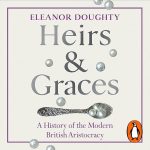
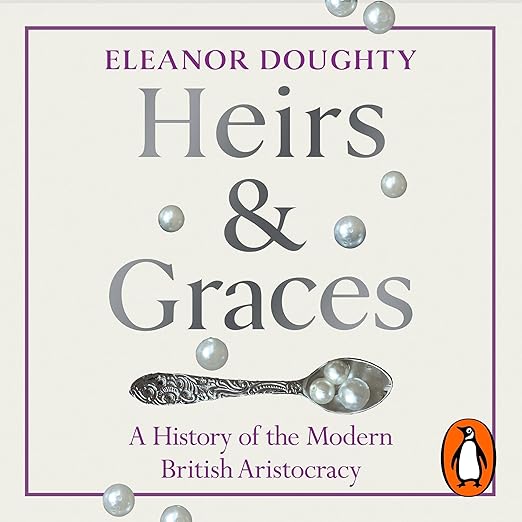
There are perhaps five thousand people who can genuinely claim membership of the British aristocracy, and Eleanor Doughty has apparently spoken to a remarkable proportion of them. Heirs and Graces is a post-war history of a class that has been declared obsolete repeatedly and keeps conspicuously failing to comply – a study in adaptation, stubbornness, extraordinary resilience, and the peculiar persistence of inherited identity in a supposedly meritocratic society. At eighteen hours it is a substantial commitment, but the material rewards the investment consistently. Julian Fellowes, whose entire television career has been built on understanding this subject, called it “deeply researched and highly entertaining.” Florence Howard’s narration is excellent. This is one of the more illuminating books about British class I have encountered.
About the Audiobook
Doughty’s primary asset is access: she has persuaded dukes, duchesses, earls, and various subsidiary members of the peerage to speak to her with a frankness that is genuinely surprising given the class’s historic reticence. The result is a portrait built from the inside rather than purely from archive – a picture of how aristocratic families actually live, argue about money, plan for inheritance, navigate marriages, educate their children, and explain themselves to a society that alternately romanticises and resents them.
The chronological sweep runs from the immediate post-war period – when the class was dismissed by a future Labour Chancellor as “selfish, depraved, dissolute and decadent” – through to the present day, where the same families manage their estates as sophisticated diversified businesses: heritage tourism, farming, film location rentals, financial vehicles. The transformation is both more dramatic and more incomplete than the popular narrative allows. Doughty is interested in the gap between the rhetoric of aristocratic decline and the reality of aristocratic persistence, and it is a genuinely fascinating gap.
Key rites of passage are examined: the boarding schools that shape identity from early childhood, the inheritance mechanisms that transfer wealth across generations, the marriages that have historically operated as strategic alliances, the death duties that have periodically seemed certain to end the whole arrangement. Along the way there are heroes and genuine villains, the eccentric and the remarkably competent, the families that have thrived by adapting and those that have declined through stubbornness or misfortune.
Doughty is not a polemicist – she does not arrive with a predetermined verdict about whether the aristocracy is a net positive or negative for British society – which makes the book more interesting than it would be if she did. She lets the material generate its own conclusions, and those conclusions are more complicated than either admirers or critics of the institution tend to allow.
The Narration
Florence Howard narrates with a composed intelligence that is genuinely well-suited to the material. She handles the considerable and complex cast of titled individuals without confusion, and maintains narrative momentum through the denser archival passages. The more acerbic observations – there are some pleasingly sharp lines buried in the research – are delivered with a dry quality that serves them well without turning the book into polemic.
At eighteen hours, the sustained quality of the narration is what prevents a long non-fiction audiobook from becoming a test of endurance rather than a pleasure. Howard never sounds either bored or breathlessly impressed by her subjects, which is precisely the right register for a book that aims at clear-eyed assessment rather than either admiration or condemnation. Her pacing through the more statistically dense passages – inheritance law, estate management structures – is careful and unhurried in a way that genuinely aids comprehension.
What Readers Say
The audiobook holds 4.3 stars from 47 ratings. Responses range from “thundering good read” (JohnHB) to “highly entertaining” (CH Gordon) to a more sceptical assessment from John C. Ward, who found the book occasionally exhausting and felt that its subjects maintained too many protective masks – a reasonable observation given the class’s entirely understandable reluctance to be fully transparent with anyone. Geoffrey Malone offered the briefest possible assessment of a book in progress: “not yet finished” with five stars, which is its own kind of endorsement. The range of responses is itself informative: this book provokes real engagement rather than polite acknowledgement.
Who Should Listen?
For anyone fascinated by Britain’s class system, the mechanics of inherited wealth and land, or the sociological question of how a hereditary elite not only survives but continues to exert disproportionate influence in a nominally meritocratic society well into the twenty-first century. Fans of Downton Abbey will find the real thing considerably more complicated, more surprising, and ultimately more interesting than the fictional version – partly because the motivations are messier than drama allows, and partly because the adaptation strategies some families have employed are genuinely ingenious.
Also recommended for political historians, sociologists studying wealth concentration and its transmission, property lawyers curious about the legal structures involved, estate agents who sell country houses, and anyone who has ever driven past a stately home and genuinely wondered what is going on inside. Available on Audible UK, Kobo, Scribd, and Storytel.