Clara’s Verdict
Naval history occupies a strange position in popular military writing: it is simultaneously one of the richest archives we have, with ship logs, signals traffic, survivor testimonies, and material evidence at the bottom of the ocean, and one of the hardest to render emotionally compelling. The geography of sea battles resists the kind of human-scale narrative that land warfare can provide. The distances are vast, the machinery is immense, the individual sailor can feel very small inside it, and the moment of decision is often invisible to the men carrying it out. Iain Ballantyne’s achievement in Killing the Bismarck is to find the human scale within the mechanical epic, and he does it primarily through the eyewitness testimonies of the men who were there: ordinary sailors on British ships who watched HMS Hood disintegrate in the Denmark Strait with all but three of her complement, who sailed destroyers through mountainous North Atlantic seas, and who stood on the decks of Rodney and King George V as they destroyed the pride of Hitler’s fleet.
I listened to this on a grey November morning when the weather felt appropriately oceanic, and the combination of Ballantyne’s research and Traber Burns’s clear narration made the eleven and a half hours pass more quickly than I expected for a subject I had approached with modest enthusiasm.
About the Audiobook
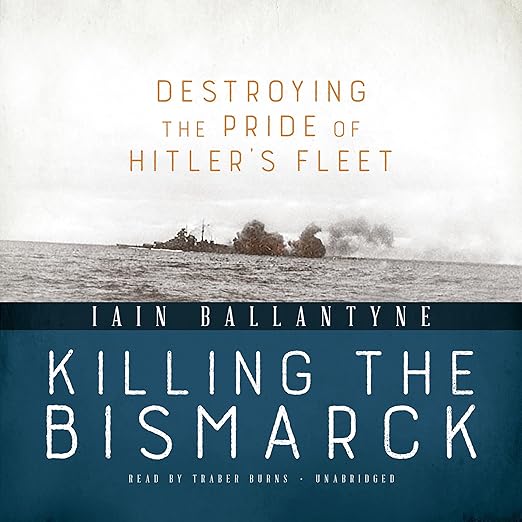
Published by Blackstone Audio in January 2017 and running to eleven hours and thirty minutes, Killing the Bismarck covers the events of May 1941, when the German battleship Bismarck and the heavy cruiser Prinz Eugen broke out into the Atlantic to attack Allied shipping. Ballantyne begins with the strategic context, reviewing the armament and capabilities of the Bismarck and the gaps in Britain’s ability to match her for speed and firepower, before moving into the operational narrative: the tense cat-and-mouse pursuit through the icy Denmark Strait, the shocking loss of HMS Hood, the battered Prince of Wales’s continuing pursuit despite her own damage, the Swordfish torpedo attacks from Ark Royal that finally crippled the Bismarck’s steering, and the last showdown with battleships Rodney and King George V supported by the cruisers Norfolk and Dorsetshire. Throughout, Ballantyne draws on the eyewitness testimony of veterans, which gives the narrative an immediacy and a human texture that purely tactical histories rarely achieve.
The Narration
Traber Burns narrates with a steady, authoritative delivery that suits the material’s combination of technical precision and personal testimony. Military history audiobooks benefit from narrators who can move between the register of tactical briefing and survivor recollection without jarring transitions, and Burns manages this consistently well. The eyewitness passages, drawn from veterans’ own words about what they saw and felt during those days in May 1941, are delivered with appropriate weight. Burns does not over-dramatise them, which respects both the historical reality and the listener’s intelligence. One reviewer describes the book as highly readable and easy to follow precisely because of how well the sequence of events and background information is organised, and Burns’s narration reinforces that structural clarity throughout.
What Readers Say
With only one Audible UK rating, the sample is thin, but broader reader responses across platforms offer more. Listeners consistently praise the book’s eyewitness-driven approach and the depth of Ballantyne’s research. The most substantive critical note concerns the final section of the book, which one reviewer felt should have been more heavily edited, suggesting that the pace drops slightly after the climactic sinking. Another reviewer is explicit about the book’s declared perspective: it tells the story almost entirely from the British side, and the German experience of those days, the conditions aboard the Bismarck, the crew’s awareness of what was coming, receives limited attention. For listeners who want a balanced account that gives the German crew’s perspective equal treatment, this limitation should be factored in before purchasing.
One reviewer with prior knowledge of the subject notes that reading this book revealed how much of the history they thought they knew was actually derived from the 1960 British war film of the same name, which suggests that Ballantyne’s account offers corrective depth for those whose understanding of the engagement is shaped by cinematic representation rather than primary source research. That is a useful function for popular history to serve, and one that Ballantyne appears to perform reliably. The book’s appendices, which are referenced in at least one review as containing material that might otherwise have interrupted the main narrative’s flow, suggest careful editorial thinking about how to balance completeness with readability.
Who Should Listen?
Military history enthusiasts with a particular interest in naval warfare and the Second World War will find this a satisfying and well-researched account. It is also accessible to general history listeners who want a single-volume treatment of one of the most famous naval engagements of the war without requiring prior specialist knowledge. The eyewitness-led approach makes it more human and more immediate than many comparable accounts of the same events. At eleven and a half hours, it rewards committed listening rather than dipping in and out, but the operational sequence provides a clear narrative thread that makes it easy to follow even across multiple sessions.