Clara’s Verdict
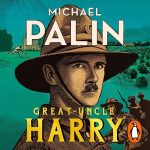
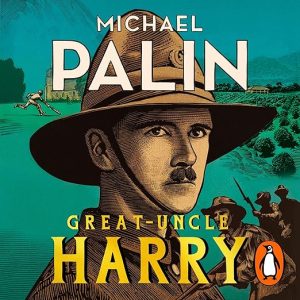
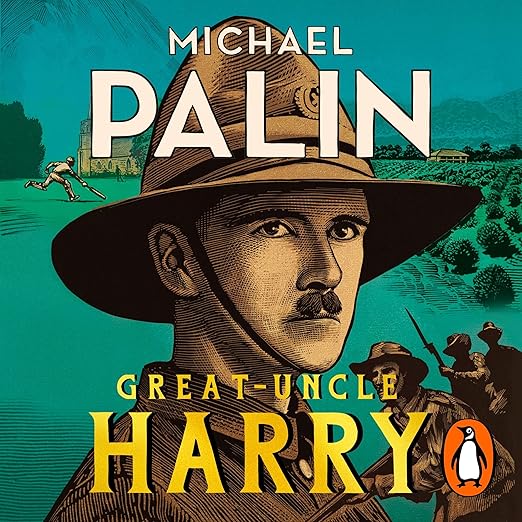
Michael Palin reading his own book about a great-uncle he never knew existed is, on the face of it, a gentle proposition – the kind of personal history project that makes for pleasant light reading without demanding too much. Great-Uncle Harry is considerably more than that. It is, in fact, one of the most quietly devastating books about the First World War I’ve encountered in years, and its power comes precisely from the modesty of its ambition. Palin is not attempting grand historical synthesis. He is simply trying to recover one ordinary man from the silence of the trenches, and in doing so, illuminates something essential about what was lost in 1916.
Rated 4.5 out of 5 from listeners. Palin narrating his own work, across seven hours and forty-six minutes, is exactly as good as you’d hope.
About the Audiobook
The book begins with a discovery: a cache of family records containing photographs of an unknown young man in army uniform. This was Harry Palin, born 1884, died 1 July 1916 – the first day of the Battle of the Somme, the bloodiest single day in British military history. Michael Palin had no idea he had a great-uncle. He decides to find out who Harry was.
What follows is a sustained act of detective work and imaginative reconstruction. Palin moves through family correspondence, official records, school archives, and military documents. He walks the landscape of northern France where Harry died. He pieces together not just a life but a world: the Edwardian boarding school culture in which Harry was formed, the social rituals and expectations of his class, the particular tragedy of a generation that reached maturity just in time to be consumed by industrial warfare.
The book broadens around its central figure – Palin devotes considerable attention to his great-grandfather’s unusual life, which turns out to be fascinating in its own right – and the result is a layered family portrait as much as a single biography. But Harry remains at the centre: the enigmatic young man in the photographs, whose life ended before it had properly begun, and whose existence was so thoroughly erased that his own great-nephew had never heard his name.
Palin’s description of this as a blend of biography, history, travelogue, and personal memoir is accurate and understated. It is all of those things, and more than the sum of them.
The Narration
Palin narrating his own work is, as I suggested, about what you’d expect – which is to say, excellent. His voice is immediately warm and familiar, and the personal nature of the material gives the narration an intimacy that no hired reader could replicate. He is reading about his own family, his own discoveries, his own grief – and that comes through in the delivery without ever becoming self-indulgent.
The Gallipoli and Somme sequences, where the historical record and the personal search converge, are particularly affecting in his reading. Palin has described in interviews how the research for this book changed his understanding of family and of loss. That changed understanding is audible in the text.
What Readers Say
Rated 4.5 out of 5 from listener reviews. “Unmissable. A true ripping yarn,” wrote one UK listener, who admitted initial uncertainty – “a biography of a seemingly obscure relative?” – before finding themselves “rapt” by the story’s expanding scope. Another described it as “wonderfully written with an immediate engaging style (it is Palin, after all).”
A more reflective review noted the book’s skill in transporting readers “most effectively, into another era of boarding schools and war” while also acknowledging that it “raises more questions than answers” – which is perhaps the most honest thing one can say about a life cut short. The descriptions of Gallipoli and the Somme were singled out as “well-told and [bringing] home just how much” was lost.
The unanimous verdict: witty, informative, emotionally resonant, and thoroughly recommended.
Who Should Listen?
Anyone with an interest in family history, the First World War, or the human cost of the twentieth century’s conflicts. Palin’s audience will find this a natural extension of the thoughtful, curious engagement with history and place that characterises his travel writing. Readers who have enjoyed Pat Barker’s Regeneration Trilogy, Sebastian Faulks’s Birdsong, or Max Egremont’s biography of Siegfried Sassoon will find this a rich companion text.
Also warmly recommended for listeners who find conventional military history too impersonal – this is about one man, and that specificity makes the scale of the catastrophe more rather than less comprehensible.
Available on Audible UK. Also check Kobo, Scribd, and Storytel.