Clara’s Verdict
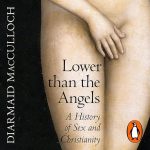
Diarmaid MacCulloch has spent his career making ecclesiastical history accessible to non-specialist readers without condescending to them or flattening the complexity that makes the subject worth examining in the first place. Lower Than the Angels is his most ambitious and, I suspect, most consequential work. A three-thousand-year history of Christianity’s encounter with sex, gender, and the family – narrated by MacCulloch himself across nearly twenty-six hours – this is not a polemic, and it is not written for one side of the culture wars currently raging through churches worldwide. It is an argument, made with the accumulated force of decades of scholarship, for paying close attention to the sheer heterodox, contradictory, perpetually surprising history of how Christians have actually thought and lived about these questions. At a moment when sexuality is the fault line on which global Christianity is fracturing, this book is not just interesting – it is necessary.
About the Audiobook
MacCulloch begins well before Jesus of Nazareth, tracing the roots of Christian sexual ethics back into the diversity of ancient Jewish practice and the complex Hellenistic world into which Christianity was born. He moves through the early church’s competing and often contradictory approaches to celibacy and marriage; the medieval construction of heterosexual monogamy as the singular Christian norm; the Reformation’s radical transformation of clerical life and the theology of marriage; and the extraordinary moral reversals of the twentieth and twenty-first centuries – the feminist movement, the partial integration of gay and lesbian Christians into mainstream church life, and the ongoing, unresolved contests over gender and trans identity.
The book’s title draws on the Biblical observation that God made humanity ‘for a little while lower than the angels.’ MacCulloch’s sustained question – across nearly twenty-six hours – is what that framing means for how Christians have understood human sexuality: is it what separates us from the divine, or is it integral to what makes us fully and properly human? The answer, he shows, has changed dramatically across time, and the present moment is not the endpoint of the story.
One of the most striking features of the book is MacCulloch’s evident refusal to write it as a brief for any contemporary position. He is himself a gay man and a committed Christian, and one might expect these facts to produce advocacy. Instead they produce something more useful: scrupulous attention to the evidence, genuine curiosity about what the historical record actually contains (as opposed to what contemporary parties would like it to contain), and an argument that the complexity itself is the point – that there has never been a single Christian theology of sex, and that the current crisis is not a departure from Christian history but a continuation of it.
The Narration
MacCulloch reads his own text, and at this length that is simultaneously a risk and a considerable asset. His voice is professorial in the best sense – measured, precise, and enlivened by the occasional dry aside that keeps the material from settling into the density it could easily achieve. He is not a trained audio narrator, and there are moments where the academic pacing shows. But the authority he brings to the subject compensates: this is, after all, Oxford’s Emeritus Professor of the History of the Church, and hearing him deliver this material in his own voice carries a weight that no other arrangement could provide. You hear someone who has thought about these questions for decades and is still, visibly, finding them genuinely interesting.
What Readers Say
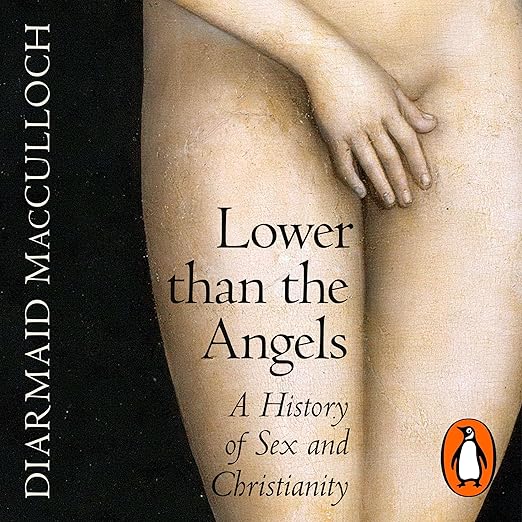
With a rating of 4.4 from 129 reviews, the book has been strongly received. “A thorough, comprehensive treatise on sex and Christianity, written to an academic standard but also an easy read – quite a feat. I found it a real page-turner, which is saying something for a book on such subject matter,” wrote one reviewer. “Must read for any Christian, or any other faith – heavy going at times, but well worth the effort. Fascinating and eyeopening history” captures another strand of response. A more critical reader found the book tailed off slightly as it reached the twentieth century – a fair point; the earlier material is richer in MacCulloch’s evident specialisation. Another objected to the cover art. The substantive responses are uniformly admiring of a major scholarly achievement that has been made genuinely accessible.
Who Should Listen?
Anyone seriously interested in how Christianity has shaped Western culture’s attitudes to sex, marriage, and gender – which is to say, anyone seriously interested in the culture wars currently consuming churches worldwide – will find this indispensable. Particularly recommended for readers of MacCulloch’s earlier A History of Christianity who want the detailed focus applied to this specific and urgent thread. Also essential for secular listeners who want to understand why sexual ethics generates such heat within religious communities: this book explains it, carefully and without partisan axe-grinding, more thoroughly than anything else available. A major work from one of the most important church historians currently writing.
At nearly twenty-six hours, this demands a significant commitment, but MacCulloch’s writing justifies it. The book is dense in the best sense – every chapter contains information and argument that matters – and the audio format, with the author’s own voice as guide, makes the density navigable. Few scholarly works of this scope have been made as accessible to non-specialist audiences, and fewer still have been as timely in their subject matter. This is essential listening for anyone who wants to understand one of the defining cultural and political tensions of the present moment.
Listen to Lower Than the Angels on Audible UK – also available on Kobo, Scribd, and Storytel.