Clara’s Verdict
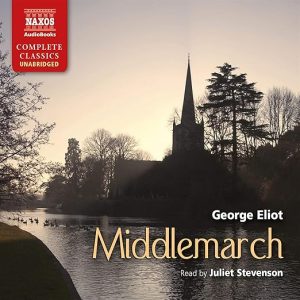
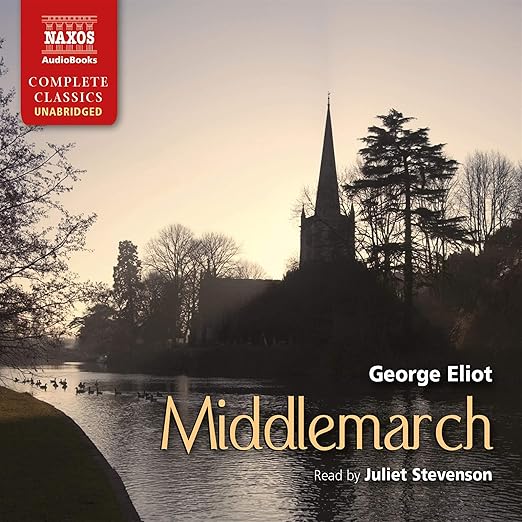
To say that Middlemarch is one of the greatest novels in the English language is not hyperbole – it is, at this point, something close to critical consensus. George Eliot’s account of the interlocking lives of a provincial Midlands town in the early nineteenth century achieves something that very few novels manage: it is simultaneously a comedy of social manners, a tragedy of missed connection, a work of political history, and a profound study of the distance between what people intend and what they actually do. Juliet Stevenson’s narration is among the finest pieces of literary audiobook performance I have encountered. This is thirty-five hours and thirty-eight minutes that will change you.
About the Audiobook
The central narrative follows Dorothea Brooke, an ardent, idealistic young woman of good family and restless intelligence, who makes the catastrophic decision to marry Edward Casaubon – a dry, elderly scholar engaged in a piece of theological research that will never be completed. Her mistake is not incomprehensible: she believes she is choosing intellectual partnership and meaningful work, not realising that Casaubon’s pedantry is a form of death. The man who understands her differently – the artist Will Ladislaw – is everything Casaubon is not, and the central emotional drama of the novel concerns whether love and duty can coexist.
But Middlemarch is not only Dorothea’s story. The town is populated with characters whose plots interweave with hers: the idealistic young doctor Lydgate and his disastrous marriage to the beautiful, shallow Rosamond Vincy; the banker Bulstrode whose public rectitude conceals private corruption; Fred Vincy’s slow moral education; the blackmail, ambition, and heartbreak that accumulate in the interstices of provincial respectability. The book is about how society constrains people – and particularly women – and how the smallness of the possible is managed by those with the intelligence to see beyond it.
The Narration
Juliet Stevenson’s reading of Middlemarch is one of those performances that sets a benchmark. Her handling of Eliot’s syntactically complex, philosophically dense prose – which requires sustained concentration even on the page – makes it sound natural and inevitable rather than laborious. She distinguishes the characters precisely without caricature, and her timing on Eliot’s famous ironic asides is perfect: the comedy and the melancholy arrive simultaneously, which is exactly what the writing demands. At thirty-five hours, this is a serious undertaking, but Stevenson makes it feel earned.
What Readers Say
UK reviewers approach this with appropriate reverence. CGKent, in their eighties and reading it for the first time, described it as “absolutely superb” – “challenging on all sorts of levels” but delivering “deep understanding of human nature and the role of society in determining behaviour.” Another listener articulated the paradox well: “How can a book written a century-and-a-half ago still exert such a powerful addiction over modern readers who imagine themselves to be free from the conventions which so shackled Victorian society?” The answer, of course, is that they are not as free as they imagine. That is precisely what Eliot was writing about.
Who Should Listen?
For any serious reader of literature who has not yet encountered this novel – a category that includes, according to many reviewers, people who have been reading seriously for decades. Also for those who have read it and want to experience what Stevenson’s voice does to the prose. This is not an audiobook for half-attention: give it the mornings, or the long walks, or the evenings when you are prepared to be changed by a book.
Listen to Middlemarch on Audible UK – one of literature’s most complete portraits of what it means to be human, in the hands of a narrator equal to the task.