Clara’s Verdict
Rowland White has built a formidable reputation for narrative military history – books that treat the human beings inside the machines as seriously as the machines themselves, and that find their tension not in set pieces but in the accumulating pressure of operational reality against strategic uncertainty. Mosquito, his account of the legendary de Havilland aircraft and the extraordinary mission that defines its wartime legacy, runs to seventeen hours and twenty-eight minutes of narrated audio and does not waste a minute. This is one of the best pieces of popular military history I have encountered in years: rigorous, propulsive, and genuinely illuminating about a corner of the Second World War that deserves far more attention than it typically receives. The aircraft was remarkable; the mission was morally complex; White’s account of both is exceptional.
About the Audiobook
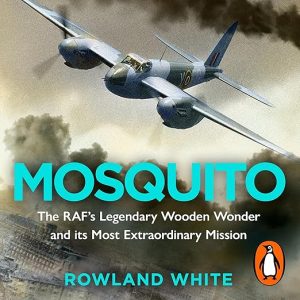
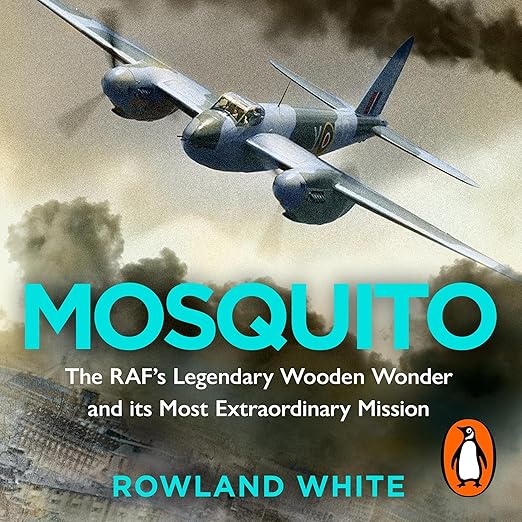
The de Havilland Mosquito was, by any technical assessment, an improbable aircraft. Built from laminated wood at a time when RAF doctrine demanded metal, powered by two Rolls-Royce Merlin engines that gave it a performance envelope the Luftwaffe struggled to match, it was dismissed by official thinking before it existed and became indispensable to the war effort once it did. Excelling simultaneously as a spyplane, night-fighter, precision bomber, and pathfinder for Bomber Command’s heavy aircraft, it was – as White argues persuasively – the answer to its pilots’ prayers: a machine capable of leaving the Luftwaffe in its wake to strike when and where the enemy was least expecting it.
White uses the aircraft’s operational history as a frame for a broader narrative about what speed, surprise, and precision can achieve – and builds to his central event: Operation Carthage, the March 1945 RAF raid on the Gestapo headquarters at Shellhuset in Copenhagen. The raid was one of the most precisely executed of the entire war. It was also one of the most morally complex: intended to destroy Nazi records and free Danish resistance fighters being held and tortured within the building, it achieved its primary objectives while also, through a navigation error, causing significant civilian casualties including children at a nearby school. White does not soften this complexity. He traces the Danish resistance story with the same meticulous care he brings to the technical history of the aircraft, and the result is a book that works on multiple levels simultaneously: as a profile of an extraordinary machine, as an account of a single mission, and as a meditation on what precision warfare actually costs.
The Narration
Roy McMillan is an experienced audiobook narrator with a particular facility for non-fiction, and his performance here is exemplary. He handles the technical passages – and there are many – with authority rather than monotony, and his pacing through the operational sequences generates genuine tension without overplaying it. The seventeen-and-a-half-hour runtime is long, but White’s material sustains every minute of it; McMillan’s narration ensures the listener never loses the thread or the stakes.
What Readers Say
The audiobook carries a 4.5-star rating, and the reviews are notably detailed and engaged. One reader who expected a concise aircraft history found something far richer: “By the end I came to fully appreciate the depth of detail that had been given and the justifications involved with one of the most famous raids.” Another was explicit about White’s credentials: “Rowland White knows his business, writes well and researches very thoroughly.” A Danish listener was moved to note that the book had illuminated a chapter of their own national history that they had not previously known, and subsequently purchased a Danish-language account of the same raid to continue their research. One reviewer who came expecting aviation history and got something broader concluded simply: “I was wrong… it quickly turns into something exceptional.”
Who Should Listen?
Essential for anyone interested in Second World War aviation, the RAF’s precision bombing campaigns, or the Danish resistance. Strongly recommended for readers who enjoy narrative non-fiction in the tradition of Ben Macintyre – where meticulous archival research is delivered with the momentum of a thriller. The operational detail is substantial enough to satisfy specialists; the human stories are compelling enough to hold readers with no prior interest in aviation. A very fine piece of historical storytelling from one of the genre’s best practitioners.
White’s previous books – Phoenix Squadron, Vulcan 607, and Harrier 809 – have established a clear methodology: deep archival research, a narrative structured around a specific operation or mission, and an insistence on the human beings inside the machines as the primary subject. Mosquito is the most ambitious of the series to date, both in terms of the historical breadth it covers and in the moral complexity of the central mission. If you have not encountered White before, this is an excellent starting point; if you have, it confirms his position as one of the best practitioners of the form.