Clara’s Verdict
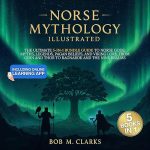
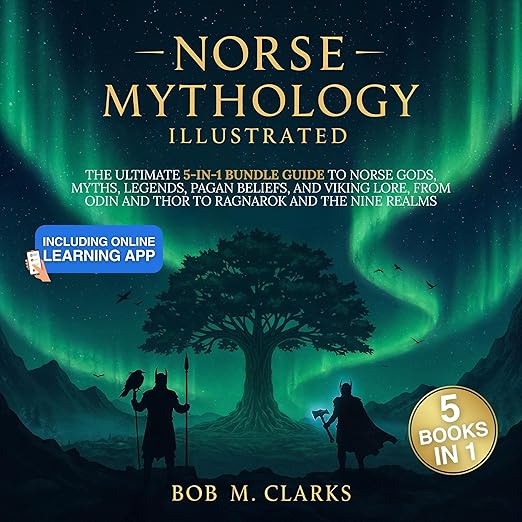
Norse mythology has had something of a popular revival in recent years – some of it excellent (Neil Gaiman’s retelling is a genuine achievement), much of it shaped more by Marvel films than by the Eddas. Bob M. Clarks’s Norse Mythology Illustrated sits firmly in the educational camp, and it has the structural ambition to match: six integrated parts, 37 chapters, a companion PDF with over 40 custom illustrations, and an exclusive Quizlet course. At just under four hours for the audio itself, it is necessarily a survey rather than a deep immersion, but as a structured and reliable entry point into genuine Norse mythology it is clear, well-organised, and refreshingly candid about what modern popular culture has and has not got right.
The market for this kind of material is broader than you might expect. There are a great many people who encountered Norse mythology through video games, fantasy fiction, or film and want to understand the actual source material – the Prose Edda, the Poetic Edda, the Icelandic sagas – without committing to scholarly editions that assume prior knowledge. This book occupies that middle ground usefully, functioning as a guided introduction that respects the listener’s intelligence without assuming expertise. The comprehensive supplementary materials – illustrations, quizzes, structured learning – make it more useful than most audio titles at comparable length.
About the Audiobook
The structure progresses logically from cosmology – the Norse universe of nine realms, the world-tree Yggdrasil, the basic structure of Norse belief – through the major mythological cycles. Odin’s sacrifice of one eye at Mímir’s well in exchange for wisdom; his self-hanging on Yggdrasil for nine days to obtain the runes; Thor’s various giant-slaying adventures, including the famous incident where he dresses as a bride to retrieve Mjölnir; Loki’s increasingly catastrophic interventions, culminating in the events that lead to Ragnarök. Each is presented with care for the original sources, distinguishing between what the Eddas actually say and what later tradition or popular culture has added.
The chapters on Viking-age paganism – runes, ritual practice, the blót ceremony, the cosmological significance of daily life – bring welcome specificity to a subject that is often handled loosely in popular treatments. The companion PDF with its custom illustrations is a genuine addition: Norse cosmology is visually complex and genuinely difficult to hold in mind without some diagrammatic support. The Quizlet course turns the audiobook into something more structured for anyone who wants to retain and test the material rather than simply enjoy it.
The Narration
Kevin Wagner narrates with a measured, clear delivery that is well suited to the encyclopaedic structure of the content. He does not attempt a theatrical Norse accent – wisely – and instead lets the material carry its own weight without theatrical embellishment. The result is clean, easy to follow, and appropriately authoritative, if not particularly distinctive in character. For a reference work of this kind, where the listener’s primary need is comprehension and retention rather than entertainment, consistency and clarity matter considerably more than performance flair, and Wagner provides both reliably throughout the three hours and fifty-five minutes. The pacing is well-judged: steady enough for the listener to absorb complex genealogical and cosmological detail without rushing, but not so slow as to feel laboured.
What Readers Say
This title is recently released and does not yet carry listener ratings. The scope of the material and the quality of the ancillary resources – the PDF illustrations in particular – have drawn advance interest from listeners approaching Norse mythology for the first time, as well as those returning to it after encountering the subject through fantasy fiction, video games, historical drama, or film adaptations. The question of what the original sources actually say, as opposed to what adaptations have made of them, is one that a surprisingly large number of people want answered, and this book is positioned well to answer it accessibly. The comprehensive structure and the Quizlet course suggest it will find a stable, ongoing audience among students, curious generalists, and the substantial community of listeners who want their mythology reliable, contextualised, and honest about what we know and what we are inferring.
Who Should Listen?
Ideal for curious listeners who want a reliable, honest foundation in Norse mythology rather than a dramatised retelling. It suits students, fantasy and science-fiction readers who want to understand the source material their favourite authors draw on, and anyone who has watched enough screen adaptations to suspect that Loki is considerably more complicated – and considerably more tragic – than any of them have shown. The short runtime and supplementary materials make this a practical first step for further reading; the Quizlet course makes it genuinely useful for anyone studying the subject formally.
Listen to Norse Mythology Illustrated on Audible UK – includes companion PDF with 40+ illustrations and exclusive Quizlet course.