Clara’s Verdict
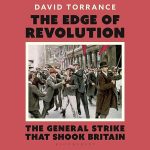
David Torrance is fast becoming the essential voice on twentieth-century British political history. His previous book, The Wild Men – about the first Labour Government – was critically acclaimed, and The Edge of Revolution, published in the centenary year of the General Strike, is its worthy successor. What distinguishes Torrance from most political historians is his commitment to narrative: he reconstructs events from inside the lived experience of participants, drawing on archival material that hasn’t previously been synthesised into accessible form. The fact that he reads the book himself is an additional bonus; the result is nine hours of listening that feels less like a lecture and more like being taken into confidence by someone who has been obsessively thinking about this for years.
About the Audiobook
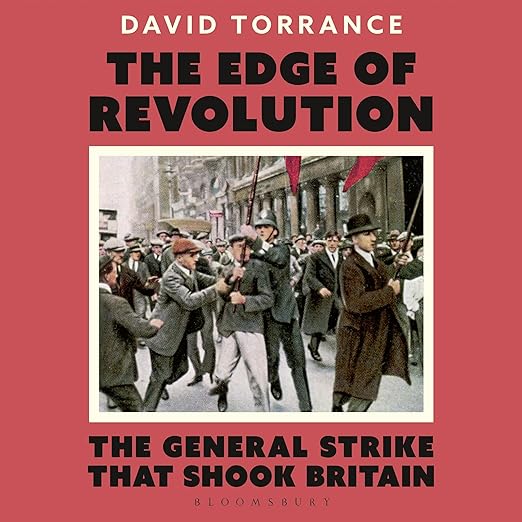
On 4 May 1926, two million British workers downed tools. The General Strike – the only truly national, all-hands industrial action ever held in Britain – lasted nine days and transformed British political life in ways that are still felt today. Torrance’s account reconstructs those nine days from the perspectives of everyone involved: the miners who initiated the strike, the Trades Union Congress leadership navigating between solidarity and legality, the Conservative government under Baldwin, middle-class volunteers who kept the buses running, and the various radicals and moderates who variously hoped for and feared an English revolution.
The centenary context matters. A century on, the General Strike occupies a peculiar place in British memory: simultaneously mythologised and misunderstood, appropriated by multiple political traditions and used to mean contradictory things. Torrance cuts through the mythology with archival specificity – quoting directly from the accounts of people who lived through those nine days – without ever sacrificing the dramatic quality of the story. The pacing is excellent: you feel the accumulating tension, the government’s careful preparation, the TUC’s growing alarm at what they had started, and the eventual, messy settlement.
The legacy sections – examining how the Strike shaped subsequent industrial relations legislation, Labour Party strategy, and British class politics – are models of concise, clear-eyed historical analysis. For anyone who uses the phrase “General Strike” without quite knowing what it entailed, this nine-hour audiobook is the ideal corrective.
The Narration
Torrance reading his own work is a significant advantage. He knows which facts are most important, which passages require pause for emphasis, and where the humour in his material is located. His reading style is unpretentious and direct – a historian talking rather than performing – and this suits the material well. Some author-narrated recordings suffer from uneven pacing or technical roughness; this has neither problem. Bloomsbury Continuum has produced a clean, well-balanced recording that does justice to a carefully written book.
What Readers Say
The Edge of Revolution carries a perfect 5.0-star rating from early UK listeners. The sole review available at the time of writing describes it as “highly enjoyable with excellent analysis” and praises Torrance’s ability to make the reader realise “how little I knew about what actually happened.” The reviewer, who had read The Wild Men and came to this with high expectations, found those expectations fully met. The centenary year timing is well-chosen: this is a book whose argument about the strike’s lasting legacy on British politics feels urgently relevant in 2026.
Who Should Listen?
Essential for anyone interested in twentieth-century British political history, the labour movement, or the social history of the 1920s. Equally valuable for listeners curious about the prehistory of contemporary British class politics. Readers who enjoyed Torrance’s previous work, or who have an interest in Juliet Nicolson’s The Great Silence or Adam Hochschild’s To End All Wars, will find much here. A serious, accessible, and thoroughly engaging piece of historical narrative.