Clara’s Verdict
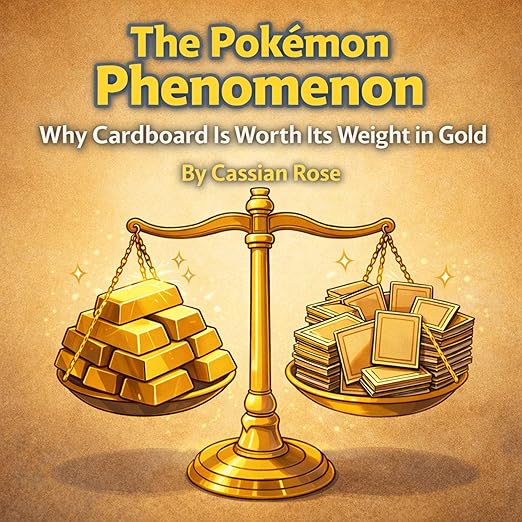
I did not expect to find myself genuinely engaged by a book about Pokémon trading cards. I should have known better. The best cultural analysis always arrives via the unexpected subject – the thing that seems too slight to carry serious weight until someone demonstrates otherwise. Cassian Rose’s The Pokémon Phenomenon turns out to be a genuinely interesting examination of how objects acquire meaning, how value is created and maintained within collector economies, and how childhood play can mature into adult culture without losing what made it worth playing in the first place. At two hours and forty-four minutes, it is short enough to listen to in a single session, but considerably more intellectually substantive than the subject might suggest to anyone unfamiliar with collector culture or the economics of the hobby market. Released in February 2026 by Zentara UK, it has not yet accumulated listener ratings, but it deserves an audience well beyond the Pokémon community.
About the Audiobook
Rose’s argument begins with an observation: the Pokémon Trading Card Game has lived three distinct lives – children’s pastime, cultural flashpoint that adults argued about in school staff rooms and assembly halls, and now a booming adult obsession with its own economy, celebrities, and mythology. Most hobbies don’t manage this. They begin as crazes, settle into niches, and either fade or become quietly institutional. That the Pokémon card has done something stranger and more durable tells us something worth understanding about how human beings relate to objects and to each other through them.
A Pokémon card is, on its face, a simple thing: a piece of cardboard with an illustration and some numbers. But its design invites the human brain to do what it always does – sort, classify, rank, collect. Multiply that card by thousands, embed it in a fictional universe that is globally recognisable even to people who have never played the game, and attach it to memories of childhood, and you have something that can simultaneously serve as a toy, an art object, a social currency, and an investment asset. Rose moves across all these registers with ease, from the psychology of collecting to the mechanics of the secondary market, from competitive play to questions of value creation and defence.
The Narration
Michelle Peitz narrates, and her delivery is clear, well-paced, and well-matched to the material. She handles the analytical passages with the same ease as the more anecdotal sections, moving between Rose’s more theoretical observations and the concrete specifics of the card world without losing the thread. The two-hour-and-forty-four-minute runtime suits her direct, unfussy style; this is not a book that benefits from theatrical delivery, and Peitz sensibly doesn’t attempt it. The writing is interesting enough to carry the listener without vocal embellishment, and she trusts it accordingly.
What Readers Say
As a February 2026 release, listener reviews are still accumulating. The book is clearly positioned at a crossover audience – dedicated collectors and investors on one side, cultural studies and pop culture readers on the other – and early signals suggest both groups find something valuable in it. Collectors appreciate the serious treatment of what they already know intuitively; readers coming from the analytical side appreciate the grounding in specific, concrete detail. The combination makes for something that neither group could have produced on their own, which is precisely what good cultural analysis should do.
Who Should Listen?
This is for anyone interested in how value is constructed and maintained around objects, how collector markets function, and how childhood enthusiasms can transform into serious adult economies and social worlds. It is also, obviously, for anyone who has ever bought a Pokémon card, has a child who collects them, or has found themselves baffled by why a piece of cardboard might sell for thousands of pounds. Rose will give you considerably better tools for understanding all of that than most resources on the subject. At under three hours, the time investment is genuinely trivial. Listen to The Pokémon Phenomenon on Audible UK – it’s a more rewarding session than you might expect going in.