Clara’s Verdict
Dan Wang has been writing one of the most thoughtful annual letters on China – and, increasingly, on the global technology and political economy landscape – for close to a decade. Those letters built a following among people who care about getting China right rather than merely confirming a prior position. Breakneck is the book that audience has been waiting for, and it largely delivers: a sustained, first-hand account of China’s economic and social transformation, built around a framework that is provocative enough to be genuinely useful and rigorous enough not to collapse under scrutiny. The “engineering state versus lawyerly state” thesis has attracted criticism for oversimplification, and some of that criticism is entirely fair. But as a lens through which to examine two very different societies’ relationships with change and institutional constraint, it is illuminating in ways that more cautious frameworks tend not to be.
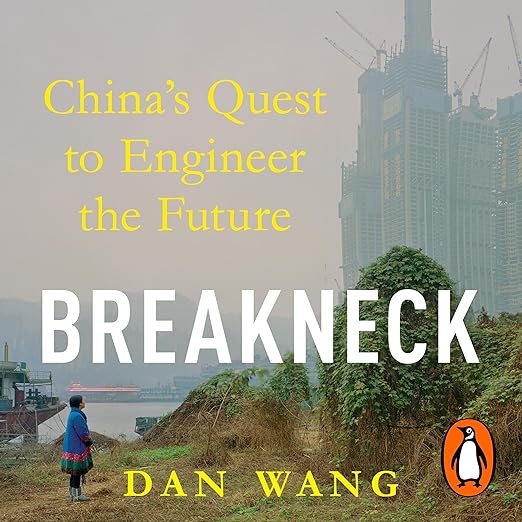
Penguin Audio’s August 2025 release carries a 4.5 rating from its initial listeners – a strong early signal for a book in a specialist niche.
About the Audiobook
Wang’s argument, stated directly: China is an engineering state – one that builds its way through problems, prioritises physical outcomes over procedural constraints, and measures success in bridges, railways, factories, and rates of economic mobility. The United States has become a lawyerly state – one where every significant change is mediated through legal process, regulatory review, and adversarial procedure, which has the democratic virtue of protecting against abuse but the practical consequence of making large-scale action nearly impossible. Each system points toward something the other needs.
This framework is developed across a book that blends political economy with reportage and personal memoir. Wang writes about China’s one-child policy with the precision of someone who has spent years reading both the quantitative data and the personal accounts. His section on China’s COVID experience – observed from inside the country – is one of the most grounded accounts of that period I’ve encountered, free from both the triumphalism of the state narrative and the reflexive Western criticism. He is careful to acknowledge what China’s engineering model costs: the individual liberties and procedural protections that the state’s relentless building programme explicitly subordinates.
The best versions of this genre – where a framework is introduced, tested, complicated, and then held up honestly against its own limitations – are rare. Wang does it. He is not a propagandist for either model; he’s a genuinely curious observer trying to understand two systems he has inhabited. Running time: 8 hours and 22 minutes – precisely the right length for what the book needs to accomplish.
The Narration
Kevin Shen narrates, and the choice of a narrator with fluency in both Chinese and American cultural contexts feels instinctively appropriate for a book that moves between them with such ease. Shen’s delivery is clear and measured – this is dense analytical material, and the narration allows listeners to absorb it rather than rushing past the complex economic arguments. The sections of personal memoir and reportage are read with appropriate warmth; the more analytical passages are handled with a slightly more formal register that suits the material without becoming remote. At eight hours and change, the runtime is calibrated well.
What distinguishes Wang’s approach from most geopolitical analysis is his willingness to sit with complexity and contradiction rather than resolving them into a simple verdict. He admires aspects of China’s capacity for state-driven action that he finds absent in American governance. He is also clear about what that capacity for action has historically been used to do – the one-child policy, the COVID lockdowns, the treatment of dissent – and does not flinch from those costs. Similarly, he criticises the legal and regulatory complexity of the American system while acknowledging that some of that complexity exists precisely to prevent abuses of power. The framework is a starting point for thinking rather than a conclusion, and Wang is honest about that distinction throughout.
What Readers Say
The five substantive UK-centric reviews available are thoughtful and engaged. One reader praised the deep-dives into China’s one-child policy and COVID experience as “enlightening and fascinating,” while noting that the engineering/lawyerly state thesis “oversimplifies” as a prescriptive framework even if it’s useful as an analytical lens. Another called it “a complete vision of the situation in China” with good comparative analysis of the relationship between the two powers. An engineer among the listeners noted they found themselves “leaning in” to Wang’s framework instinctively. A fourth called it “fascinating and absorbing, combining personal experience and analysis.” The 4.5 rating reflects a genuinely engaged early readership.
Who Should Listen?
Anyone trying to understand the US-China relationship with more nuance than the prevailing media narrative allows will find this valuable. Wang is not an apologist for the Chinese state – he is clear-eyed about what the engineering model suppresses – but he is also not performing alarm for an already-alarmed audience. Readers who have engaged with Michael Pettis on China’s economic model, or with more historical accounts of Chinese state-building, will find this a valuable contemporary complement. Those who follow Wang’s annual letters and have been waiting for the long-form version: this is it, and it is worth the wait.
Listen to Breakneck on Audible UK: Find it on Audible UK. Also available via Kobo, Scribd, and Storytel.