Clara’s Verdict
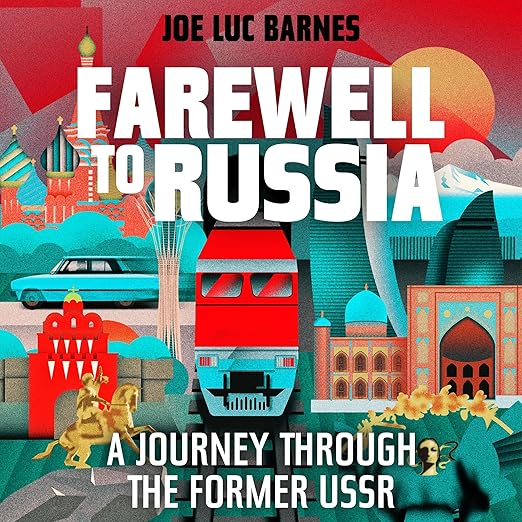
The post-Soviet space has never been more urgently relevant to Western readers, and Farewell to Russia by Joe Luc Barnes is exactly the book we need right now: a travelogue that is genuinely curious, rigorously observed, and written with a dry wit that makes the darkness it frequently encounters bearable without ever minimising it. Barnes crossed the former USSR in the wake of Russia’s invasion of Ukraine, visiting all fifteen successor states – from Estonia’s tech-hungry optimism to the surreal authoritarianism of Turkmenistan, from the medieval streets of Georgian old towns to the former gulags of Kazakhstan – and what he found was far more complicated, more human, and more affecting than any political briefing could capture.
Rated 4.9 from 11 reviews – an exceptional opening score – this is a book that has found its audience quickly and held it. The publisher’s comparison to Bill Bryson is apt but undersells the work: Barnes is funnier in places, angrier in others, and considerably more politically alert throughout. The combination of travel writing, contemporary journalism, and post-imperial history is handled with a skill that makes this one of the most accomplished debuts in the genre I have read in recent years.
About the Audiobook
The premise is deceptively simple: thirty-five years after the Soviet Union’s collapse, what actually happened to the other fourteen republics? The clichés – snow, concrete, the KGB – apply to none of them in quite the ways Western audiences might expect, and Barnes travels by rattling platzkart train, hitchhiking across long stretches, and occasionally in the white cars mandated by Turkmenistan’s eccentric dictator to find out.
What he encounters is a chorus of voices that the West rarely hears and has little framework for: nomads in mountain yurts who have adapted to the post-Soviet economy in unexpected ways, TikTok-fuelled activists agitating for change in countries where that carries genuine risk, small-town taxi drivers with complicated feelings about Moscow that don’t resolve into the simple pro- or anti-Russian positions Western media tends to demand, Soviet nostalgics and their children who never shared those years and have built entirely different expectations for their future.
Barnes moves fluently between historical analysis – the book provides compact, contextually useful background for each country’s particular trajectory since 1991 – and intimate individual encounter, and the movement between those registers is skilfully managed throughout. The question that gives the book its title – can these states ever truly say farewell to Russia, even those that desperately want to? – is one that the contemporary moment makes urgently relevant, and Barnes resists the temptation to answer it too cleanly or too soon. It is a question the book leaves alive, as it should be.
The Narration
Matt Addis narrates, and it is a well-chosen match for the material. Addis has the ability to move between the comic and the genuinely harrowing without the tonal shift feeling jarring – essential for a book that can move from a genuinely funny encounter with Georgian bureaucracy to a quietly devastating conversation with someone who carries the weight of the Soviet penal system within a few pages. His delivery of the historical passages is clear and authoritative without becoming academic, while the individual voices he finds for the various figures Barnes encounters along the way add texture and humanity. At twelve hours and sixteen minutes it sits at a satisfying length – substantial enough to feel like a real journey, contained enough not to overstay its welcome.
What Readers Say
Rated 4.9 out of 5 from 11 reviews, with UK listeners dominant among the early responders and uniformly enthusiastic. One described it as “insightful, funny and entertaining,” praising both the historical context and the individual human portraits as equal in quality. Another UK reviewer called it “an incredible piece of writing following an amazing journey,” asking when the next book would be out. A third highlighted what they found most valuable: the challenge it poses to Western assumptions that post-Soviet states are unambiguously better off since 1991, finding Barnes’s willingness to sit with complexity and contradiction genuinely illuminating rather than defeatist. One reader with existing knowledge of the Silk Roads region found this brought contextual depth that complemented their prior reading and changed several assumptions they had held.
Who Should Listen?
Essential for anyone with an interest in Russia, the former Soviet republics, or the current conflict in Ukraine who wants something more human and less analytical than conventional geopolitical writing. Readers who loved Peter Frankopan’s The Silk Roads, Barbara Demick’s Nothing to Envy, or Rory Stewart’s The Places in Between will find this in exactly the same spirit and at the same level of quality. Also deeply enjoyable for armchair travellers who appreciate dry wit alongside genuine scholarship – and for anyone who has looked at a map of the former Soviet space and wondered what is actually happening in those places the news occasionally mentions but rarely explains.
Farewell to Russia is available on Audible UK via the link below. Also available on Kobo, Scribd, and Storytel.