Clara’s Verdict
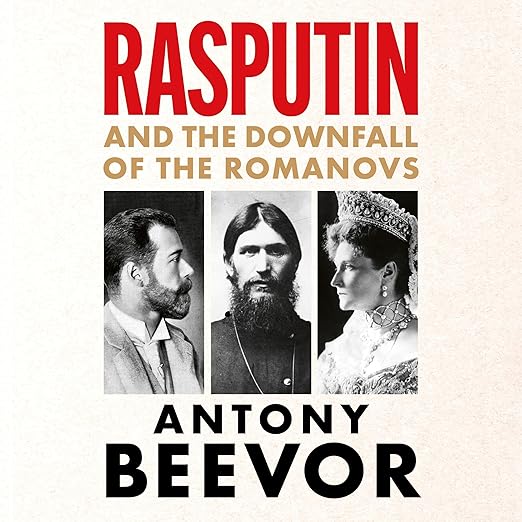
Antony Beevor is one of those rare historians who can make you feel the weight of contingency – the sense that things could have gone otherwise, that the collapse of empires is not inevitable until, suddenly, it is. Rasputin, his study of the barely literate Siberian peasant who bewitched the last Romanovs and – Beevor argues – contributed more to the fall of the dynasty than any other individual, is a masterclass in what narrative history at its best can achieve. It takes a figure so encrusted in legend and popular mythology that he has become almost fictional, and slowly, methodically, reveals the human mechanisms of his power. The Sunday Times called it an instant bestseller. It deserves the description.
What distinguishes Beevor’s approach from the sensationalised accounts that have dominated Rasputin’s popular reputation since his death is the rigour and patience with which he separates documented fact from embellishment, rumour, and the active myth-making that both the Romanovs’ enemies and Rasputin’s own associates engaged in during his lifetime. This is a book about myth-making as much as it is about the man himself, and that dual focus gives it an analytical depth that most popular biographies of Rasputin do not attempt.
About the Audiobook
Beevor frames his inquiry around a genuine historical puzzle: how could a man with no official position, no forces at his command, and no formal education whatsoever come to determine the fate of the greatest autocracy on Earth? He traces Rasputin’s origins in western Siberia, his development as a wandering holy man of uncertain orthodoxy, his introduction to the Imperial court, and the extraordinary intimacy he developed with Empress Alexandra – rooted, Beevor demonstrates, in her desperate belief in his ability to manage her son Alexei’s haemophilia through prayer and presence.
The portrait that emerges is more nuanced than popular culture allows for. Rasputin was a convinced monarchist, not a revolutionary; his influence operated through the intimate anxieties of the Imperial family rather than through any political ambition. Yet the rumours about his conduct – sexual, political, spiritual – so demoralised the Tsarist officer corps and undermined the regime’s legitimacy that when the February Revolution arrived, not a sword was raised in defence. Beevor’s post-mortem asks, finally, whether the real legacy of Rasputin was not what he actually did but what people believed he was capable of doing. The answer is one of the more unsettling lessons in the history of power.
One dimension of Beevor’s argument that particularly struck me: his examination of how Rasputin’s enemies – the aristocrats and politicians who eventually murdered him – were themselves partly responsible for amplifying his legend and thereby accelerating the very collapse they were trying to prevent. The attempt to destroy a myth can become the act that makes it permanent. That insight has applications well beyond the specific historical case, and Beevor is too good a historian not to notice them.
The Narration
Rob Heaps narrates with the careful authority that Beevor’s dense, precisely evidenced prose demands. At eleven hours and fourteen minutes, this is a substantial listen, and Heaps maintains an even, engaged delivery throughout. He handles the Russian names, titles, and court protocols competently – a non-trivial challenge in any work set at the late Tsarist court – and brings appropriate gravity to the book’s more dramatic passages without tipping into theatre. This is narration in the classic non-fiction mould: authoritative, clear, and entirely in service of the scholarship.
What Readers Say
Rated 4.7 out of 5, with UK listeners offering consistent and thoughtful praise. One reviewer noted: “You quickly realise how the mistakes of the Romanovs and those around them led to revolution and ultimately doomed their dynasty – the book makes the historical logic feel almost inevitable in retrospect, which is itself uncomfortable.” Another acknowledged the density: “ideal for anyone into Romanov history, but quite involved for the everyday reader.” A third – and I find this the most revealing response – said simply that they could not put it down, which is a remarkable reaction to an eleven-hour scholarly history. Simon Sebag Montefiore, quoted on the cover, calls it “one of the great stories of history, told by one of our greatest historians.” Anthony Horowitz adds: “this extraordinary story has never been better told.” Dan Snow calls it “the gold standard of narrative history.” These are not casual endorsements, and they are earned.
Who Should Listen?
Essential for anyone interested in Russian history, the late Tsarist period, or the mechanisms by which myths shape political events. If you have enjoyed Beevor’s Stalingrad or Berlin, this operates in a more intimate register – biography and psychology rather than sweeping military history – but with the same meticulousness and narrative assurance. Readers of Simon Sebag Montefiore’s Romanov histories will find Beevor’s Rasputin a natural and compelling companion. This is also, more broadly, a book for anyone interested in how individuals shape history, and how history shapes the way we remember them.