Clara’s Verdict
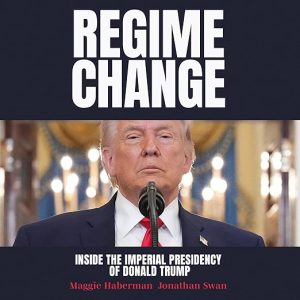
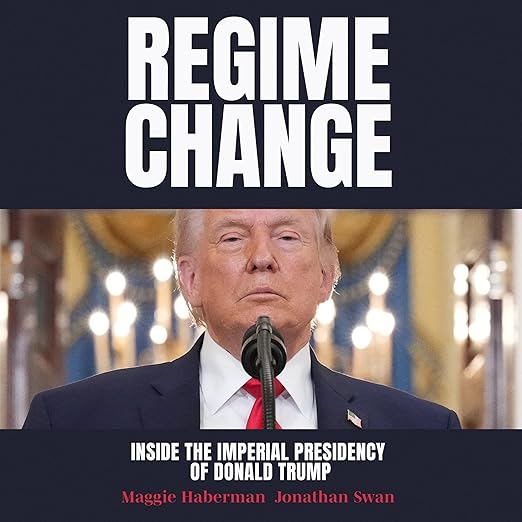
Seventeen hours and seven minutes of political reporting is a serious undertaking, and the first thing to say about Regime Change is that it justifies the length. This is the account of the first year of Donald Trump’s second presidency, assembled from hundreds of interviews and from reporting inside rooms that were never meant to be reported from, and the detail is the product rather than the packaging.
The second thing to say is a correction to the listing. This audiobook is credited here to Maggie Haberman alone, but the publisher’s own description names two authors, Jonathan Swan and Maggie Haberman. Swan’s contribution is not incidental, and I would not want anybody to assume this is a single author book merely because a catalogue entry says so.
It has been a number one New York Times bestseller and an instant Sunday Times bestseller. It holds an average of 4.6 across fourteen hundred ratings, and it has become one of the non-fiction titles UK listeners are working through in numbers right now. Robert Petkoff narrates, which is close to ideal casting for reasons I will come to.
About the Audiobook
The organising argument is stated in the opening lines of the description and it deserves to be taken seriously, because it is a genuine reporting thesis rather than a slogan. Few people expected Trump to return to the White House stronger than he left it. The indictments, the convictions, the assassination attempts and four years of political exile are presented here as having made him not weaker but more powerful, more vengeful and more willing to gamble than any president before him.
What follows from that is a book about the removal of constraints. Swan and Haberman are examining a second term explicitly described as liberated from every limit that defined the first, and the reporting concentrates on decisions and on the people who made them possible. The blurbs on the listing tell you what kind of journalism this is. Tina Brown, writing in the Observer, called it a flabbergasting feat of political reporting and found “A news bomb on every page”. The Guardian called it “A blockbuster”. The Financial Times found it “Deeply reported and gripping”. David Remnick, in the New Yorker, described it as “packed with news that will stay news”.
That last phrase is the one I would hold onto. A great deal of political publishing is disposable by design, written to be argued about for a fortnight and then forgotten. The claim being made for this book, and the reason it has sold as it has, is that the underlying reporting will still be load-bearing in ten years. The listing also notes, with some relish, that it prompted leak inquiries inside the White House, which is its own form of review.
The Narration
Robert Petkoff has long been one of the narrators I trust most with political and historical non-fiction, and the reason he suits this particular book is temperamental rather than technical. His register is that of an investigative reporter reading his own copy: measured, evidence-forward, entirely uninterested in telling you how to feel about what he has just told you.
That neutrality is not a small thing here. A book about a sitting president, reported at this level of detail, could be sunk inside the first hour by a narrator who editorialises with his eyebrows. Petkoff does not. He reads the most extraordinary anecdotes at the same temperature as the procedural background, and the effect is to make the extraordinary material land harder, precisely because nothing in the delivery is asking you to be shocked.
Seventeen hours also demands stamina of a specific kind. This is dense reporting with a very large cast of officials, advisers and appointees, and the listener needs to hold who is who across a long span. Petkoff is good at the small register shift that signals a quoted source, which is the single most useful technique in reported non-fiction, and he manages it without turning interviewees into characters. If you have listened to his political and historical work before, this is that register applied to the most current subject imaginable.
What Readers Say
An average of 4.6 from fourteen hundred ratings is high for a political book, a category that usually attracts organised disapproval alongside the praise, and the written responses suggest the reason is craft rather than partisanship.
“The explanations of events and the even-handed portrayal of characters give a far better insight into the heart of US government than will be found in most news articles that have to be written in haste.”
That reviewer, posting as not Mark Twain, makes the case for the book as reporting rather than commentary, describing it as very readable and well organised. Another calls it a well written account of the inner workings of the Trump government and recommends it to anybody interested in American politics.
The most useful review is the four star one, because it contains an actual criticism. GW came in believing they already knew a great deal and still found the individual contributions to meetings revealing, describing the amassing of power by unelected people as frightening and astonishing. Their complaint concerns omission. They noticed no mention of what they call the numerous u-turns by the current government, and were unsure whether that was a deliberate editorial choice. Written by a UK reviewer, that phrase is not perfectly clear about which government is meant, but the reservation about omissions stands either way. That is a fair and specific reservation, and exactly the sort of thing worth knowing before you commit seventeen hours.
Who Should Listen?
Regular readers of American political journalism are the natural audience and will need very little persuading. If you follow the story closely and want the documented version rather than the commentary version, this is a genuinely substantial account of the period, and Petkoff makes the length manageable.
It is a harder recommendation for casual listeners. The density that makes it valuable also makes it demanding, and a book assuming familiarity with the cast of an administration will be heavy going if you do not already know who most of these people are. Anyone looking for either denunciation or defence will be disappointed too, since the reporting is deliberately cooler than its subject. But for anyone who wants to understand how the decisions of this year were actually made, rather than how they were subsequently explained, Swan and Haberman have done the work.