Clara’s Verdict
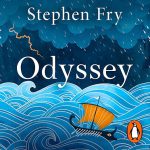
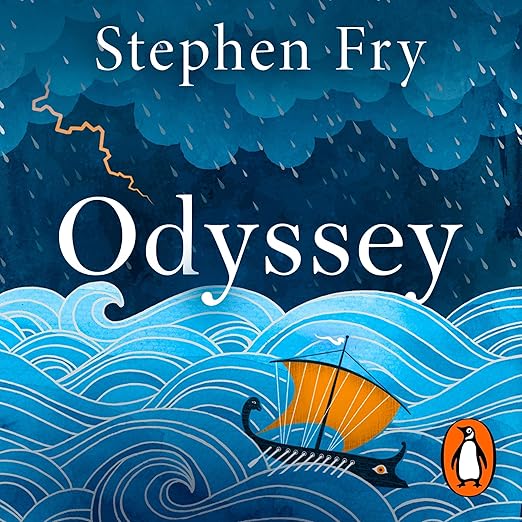
Stephen Fry has been retelling Greek myth for long enough now that the project has its own shape, and Odyssey is the fourth volume, the one that sets Odysseus sailing for home and brings the sequence to a close. It runs ten hours and thirty-six minutes on a Penguin credit dated 26 September 2024, and it holds a 4.6 average from 2,016 ratings. I think it is the strongest possible argument for taking Homer in audio, which is a slightly awkward compliment to a retelling rather than a translation, but I mean it: this is the version to put in the hands of someone who has always felt they should have read the poem and never has.
My reservations are two, and both come from a reader rather than from me: a shift between Greek and Roman naming that struck him as jarring, and a substantial amount of end matter, which means less story inside the running time than the running time implies. Neither is fatal. Both are worth knowing before you start.
About the Audiobook
Troy has fallen, and the King of Ithaca points his ships towards Penelope and home. The gods, who are angry with him, spend the next decade making sure he does not arrive. What the publisher promises along the way is a catalogue of obstruction: giants and monsters to torment him, witches and goddesses to tempt him, and a shoreline that keeps receding as he closes on it. Penelope meanwhile refuses to believe the reports of his death, and is besieged at home by young men who want the marriage and the throne with it. The listing’s tagline frames it as vengeful gods against ordinary courage.
On reading order, the listing is clear. This is number four in Stephen Fry’s Greek Myths, and the press quotations describe it as the closing volume, with the Guardian calling it a satisfying end to the four-book sequence and the Irish Independent saying it completes the series in marvellous fashion. The Observer praises the whole set as an outstandingly entertaining quartet of books.
Here I have to note a contradiction rather than smooth it over. One of the reviewers on this listing, writing in October 2025, closes by saying they “look forward to the last book in the series”, which does not sit easily with a publisher description that presents this as the finale. I cannot resolve that from the information available. It may be a reader who lost count, or it may reflect something the copy is not saying. If completing a series is your reason for buying, treat the four-book framing as the publisher’s claim rather than a settled fact.
What Fry is actually doing, on the evidence of the response, is making the poem legible without gutting it. One reader calls him “a master storyteller, who is both scholarly and very amusing”, which is a fair summary of the balancing act the book pulls off. That cross-referencing is the real service of a four-volume approach: by the fourth instalment, the gods have histories you already know.
The Narration
Nobody is credited with the reading here, and I am not going to fill that gap with an assumption. What the listing does carry is a Penguin Audio production credit for 2024 alongside Fry’s own 2024 copyright, so this is an in-house recording of a book by an author who is also a working broadcaster and actor. If it is Fry himself at the microphone, the fit is self-evident, and the reader who praised the scholarship and the wit would turn out to have been describing a performance as much as a prose style. But the listing does not confirm it, so please check the credit on the product page before assuming.
What the material demands is worth spelling out regardless of who delivers it. This is a story of ten years of wandering, which by its nature means a long run of separate episodes and a cast to match, large enough that by one reviewer’s account a character list has been appended to the end. On the page that is exactly the kind of structure readers lose their footing in. A reader who keeps the cast straight turns those episodes into the pleasure rather than the obstacle, and that is the specific reason a retelling of this story belongs in audio.
The one reservation I would carry into any listen comes from the four star review, which found the chapter using Roman names rather than Greek “a little jarring” and felt it detracted from the storytelling. In audio that switch is harder to absorb than on the page, because you cannot glance back to check which name belongs to whom. Anyone shaky on which goddess is which should expect a wobble at that point.
What Readers Say
For a mythology retelling released as recently as late 2024, that is a healthy consensus. The most enthusiastic of the three reviews on the listing is unreserved, calling the retelling perfectly judged for a modern readership, and would award it more than five stars if the system allowed. A second five star reviewer keeps it to a sentence and picks the two things that matter most in a retelling, calling it “Very readable and faithful to the original”.
The four star review is the practically useful one and I want to draw out its second point, because I have not seen it made elsewhere. Beyond the Roman naming complaint, that reader notes that the book carries a rather large afterword and character list at the end, “so isn’t as long as it appears.” In print that is a mild surprise. In audio it is a genuine planning consideration, because if that end matter falls inside the stated running time you are buying hours of something other than the story, and a character list read aloud is a very different experience from one you can flick to. That same reader still recommends it warmly, and the word chosen for the retelling is clear.
Who Should Listen?
Newcomers to Homer are exactly who this was made for. If your knowledge of Odysseus amounts to a handful of half-remembered monsters and one very patient wife, Fry’s approach is designed to give you the whole shape without demanding you first acquire a classical education. Readers of the previous three volumes have an obvious reason to continue, and one reviewer confirms that the links back to the earlier books are made explicit. It should also suit older teenagers, bearing in mind that the publisher’s own summary promises monsters and seductions rather than a tidied-up children’s version.
Look elsewhere if you want a translation rather than a retelling. Fry is rewriting the story for a modern ear, humour included, and a listener hoping for the austere music of the original will find the register too companionable. Purists who care about consistent Greek nomenclature should also weigh that four star reviewer’s complaint seriously. For everyone else, ten and a half hours is a fair trade for finally knowing the story properly.