Clara’s Verdict
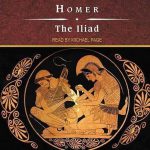
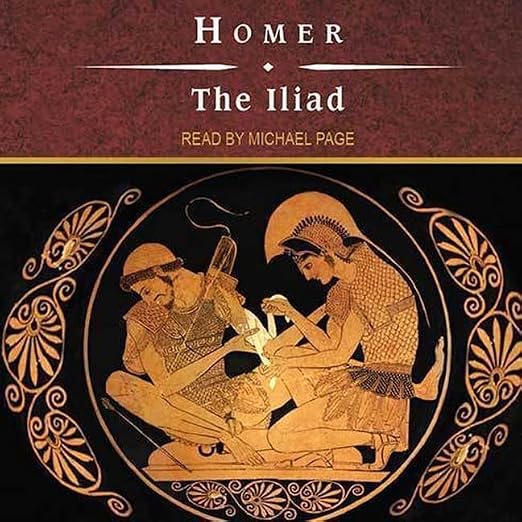
There is one line in this listing that matters more than everything else on the page, and it is the last one: “This version of the Iliad is the translation by Alexander Pope.” Whatever you think you know about buying an Iliad, that single sentence changes it. You are not being offered a plain modern prose rendering of Homer. You are being offered a poet’s Iliad in English verse, which is a substantially different object and a substantially different listening experience.
I say this without any hedging: choose your translation before you choose your narrator. It is currently sitting high in the Audible UK charts, and I would guess a fair number of people are buying it because it says Homer on the cover without registering what sits underneath. Get the choice right and this is transporting. Get it wrong and you will stall in the second hour.
About the Audiobook
The poem covers the darkest episode of the Trojan War, and its subject is not the war but a sulk. Achilles, the greatest fighter the Greeks possess, is humiliated by Agamemnon and withdraws from the fighting. Men die because of it. When the Trojan Hector kills Patroclus, who was closest to him, Achilles returns to take his revenge knowing perfectly well that doing so guarantees his own early death. That is the whole shape, and it is astonishing how modern the psychology remains.
What surrounds it is the reason people return to Homer rather than merely respecting him: the domestic world inside the besieged city of Ilium, the gods on Olympus bickering over the fates of mortals with the pettiness of a family at Christmas, and the extraordinary battlefield descriptions that move between panorama and a single dying man without ever losing focus. The publisher’s description rightly notes that even the heroic code itself, with its emphasis on pride, honour and submission to the will of the gods, is not left unquestioned.
Two practical gaps in this listing deserve mention. No narrator is credited and no runtime is stated. For a work on this scale, from Tantor Audio and dating to 2010 in this edition, both are things I would want confirmed before committing, and I would check them on the product page rather than take my word or anyone else’s.
The Narration
With no performer named, I can only tell you what this text asks of one, and Pope asks for something quite specific. English verse read aloud has a pulse, and a narrator who fights that pulse produces something stilted, while a narrator who surrenders to it entirely produces a metronome that puts you to sleep well before the halfway mark. The correct performance sits between: the metre audible underneath, the sense carried on top.
This is genuinely one of the places where audio can beat the page. Homer was composed to be heard, and the epithets that irritate readers on paper, those fixed formulas bolted to every hero and every stretch of sea, do in performance exactly what they were built to do. They are handholds. One reviewer confessed to liking all the epithets while still getting the characters mixed up, which is a very honest account of how the poem behaves for a first-time reader and a good argument for hearing rather than reading it.
Sample before you commit. I would say that about any classical epic, and I would say it twice about a verse translation, where a single unsuitable voice can close the door on the poem entirely.
What Readers Say
The score sits at 4.4 from 3,034 ratings, and I need to be candid about what that figure represents. The reviews visible here describe reading the poem rather than listening to it, and two of them date back to 2013 and 2014, well before this edition would have reached most people. Treat the number as a verdict on Homer, which is hardly in doubt, rather than on this particular recording.
The reviews are still worth having, because they capture the honest experience of a first encounter better than any critical apparatus. One reader described picking it up and thinking “this is going to be a challenge to get through!”, then being caught anyway:
I was quickly intrigued in the story of this Homeric epic
Another admitted to having been thoroughly bored at the time and glad of it afterwards, and recommended putting the poem on a lifetime list rather than a weekend one. A third offered only “Classic. Very good choice”, which is not analysis but is a fair summary of three thousand years of consensus. Charmingly, more than one reviewer calls it a novel. It is not, and the gap between what people expect and what Homer actually delivers is the single largest cause of abandoned copies.
Who Should Listen?
Pope’s verse is the deciding factor, so let it decide. If the idea of Homer rendered by an English poet appeals, if you have read Pope or Dryden with pleasure, or if you want the Iliad as poetry rather than as story, this is the edition you want and the reason to choose it over the modern alternatives. Long commutes and long walks suit it particularly well, because the poem rewards being carried rather than studied.
Anyone approaching Homer for the first time and wanting the plot to come through cleanly may find a contemporary prose translation kinder, and there is no shame whatsoever in starting there. I would also hesitate to recommend this format to a student needing to cite passages, since verse in audio makes locating a line considerably harder than a printed edition does. Everyone else should simply be warned that the gods are worse behaved than they remember.