Clara’s Verdict
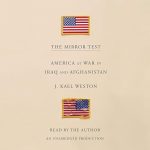
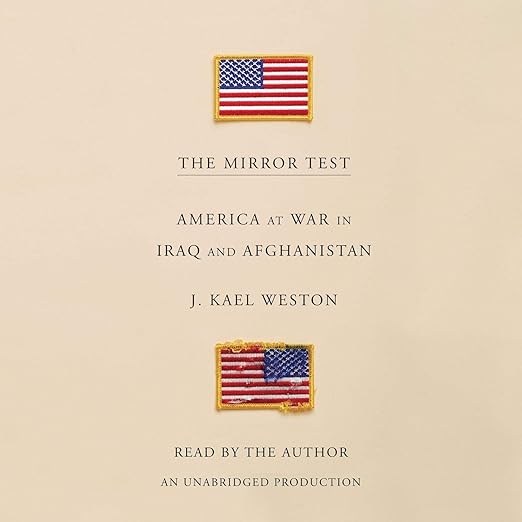
J. Kael Weston spent seven years working for the US State Department in some of the most dangerous frontline positions in Iraq and Afghanistan – not as a soldier, but as a civilian diplomat embedded with troops, attempting the impossible work of building something durable in the middle of ongoing destruction. The Mirror Test is his account of that experience, and of the years he spent afterwards travelling the United States to pay respect to the dead and wounded. It is a book about the human cost of these wars in a way that is almost intolerably honest, and which asks questions about accountability and memory that the public conversation around both conflicts has largely preferred to avoid.
Weston narrates his own work, and there are moments in that twenty-two-hour listen where the weight of what he is recounting is audible in the pauses. That quality of witness – the author as both participant and mourner – makes this one of the most important war memoirs of the past two decades.
About the Audiobook
The book takes its title from a specific moment in the recovery of severely wounded soldiers: the first time a patient with a reconstructed face must look at themselves in a mirror. Weston uses this as his central metaphor – extending it outward to the question of whether America, as a nation, can look honestly at what these wars have produced and what they have genuinely cost.
The scope is deliberately wide. Weston moves between Fallujah, Helmand, and Khost in the war years, and between military bases, congressional offices, and small-town memorial services in the years that follow. He interviews generals and corporals, senators and imams, Afghan schoolteachers and former Taliban fighters, SEAL teams and the families of Marines who did not come home. The portrait that emerges is of enormous complexity and no easy consolations.
What distinguishes The Mirror Test from most war writing is Weston’s refusal to separate the military and political dimensions. He was a diplomat working alongside troops, which gives him a perspective on both the tactical and the strategic, and he is unflinching about the ways in which American policy – well-intentioned and otherwise – shaped the ground-level reality he witnessed. The book is dedicated to the dead of both sides, and that scope is reflected throughout in whose voices are heard. Published by Random House Audio, this is a New York Times Editors’ Choice, running 22 hours and 24 minutes.
The Narration
Weston reads his own work, and this is not always a guarantee of quality – authors do not always suit the form. Here it is clearly the right decision. His voice carries the weight of personal experience without becoming confessional in a self-indulgent sense: he is bearing witness to other people’s losses as much as to his own. The pacing is slow and considered, which suits material that asks a great deal of the listener’s emotional attention. Twenty-two hours requires stamina on both sides of the recording, and Weston earns the attention throughout.
What Readers Say
The Mirror Test holds a 4.7 rating from 108 Audible listeners. One US reader, who had read over a hundred military history books, called it “right up at the top of the list” and “a must read,” praising its “deeply personal look at how war affects people at all levels of involvement, from the most powerful Presidents to the most powerless.” Another described it as “a unique and complete viewpoint” that blends perspectives in a way that should be a “civilian’s duty to read and understand.” The few dissenting voices find the writing occasionally dense or over-reliant on accumulated detail – a fair observation – but the majority response is that this is a book of genuine moral seriousness that refuses the comfortable frameworks most war writing relies on.
Who Should Listen?
This audiobook is for readers who want to understand what the Iraq and Afghanistan wars actually meant at the human level – not the geopolitics, which has been covered extensively elsewhere, but the reality on the ground, and the long questions of accountability and memory that outlast the fighting. It will particularly reward listeners interested in diplomatic history, military ethics, and the complex aftermath of conflict. It is not easy listening – Weston is honest about atrocity and failure without sensationalising either – but it is important, morally serious, and deeply humane. Set aside time for reflection alongside the listening. Available on Audible UK, Kobo, Scribd, and Storytel.