Clara’s Verdict
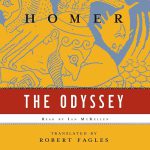
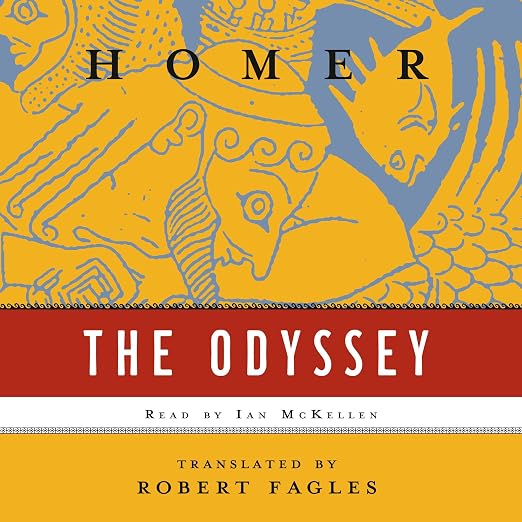
Ian McKellen reading Robert Fagles’s Odyssey is one of those pairings that sounds inevitable in hindsight and was not obvious at all when it was made. This recording dates from December 1999. It has outlived a great many flashier productions, and it is back in the Audible UK charts now, more than a quarter of a century later, which is not something you can say about much audio.
Part of the reason is Christopher Nolan, whose film adaptation the publisher is already advertising on the listing. But the recording would deserve its revival regardless. Fagles’s translation is the one the publisher rightly calls accessible, and McKellen reads it as verse rather than as a story that happens to be arranged in lines. Thirteen hours and three minutes is a serious sitting and I will not pretend otherwise.
If you have circled Homer for years and never quite got in, this is the recording I would put in your hands. I have given it to more reluctant readers than any other classical release, and it works because Fagles supplies the momentum and McKellen supplies the sound.
About the Audiobook
Fagles won the PEN Ralph Manheim Medal for Translation and an Academy Award in Literature from the American Academy of Arts and Letters, and this translation is a large part of the reason. It is worth quoting the opening, because it tells you immediately what sort of English you are getting: “Sing to me of the man, Muse, the man of twists and turns driven time and again off course, once he had plundered the hallowed heights of Troy.”
That is neither archaic nor slangy. It has forward pressure and a genuine speaking rhythm, which is exactly what an audiobook needs and what stiffer verse translations cannot supply. Jasper Griffin, reviewing it in the New York Times Book Review, called it “a distinguished achievement”, and Penguin have been quoting that assessment ever since, because it is accurate.
As for the poem, the publisher offers a useful comparison: if the Iliad is the great war epic, the Odyssey is literature’s grandest account of an ordinary life’s journey. Odysseus survives ten years of gods, monsters and weather on wit and cunning rather than on strength, and the poem is at once a timeless human story and a test of one man’s moral endurance. What strikes me on relistening is how domestic it all is underneath the sea monsters. This is a poem about a man trying to get back into his own house, and about the people who have been living in it while he was away.
The Narration
McKellen does the one thing this poem needs above all others, which is to trust it. There is no attempt to modernise the delivery and no self-conscious effort to make Homer approachable. He reads the lines with the weight they were written to carry, and lets the translation do the work of clarity.
His handling of the formulaic passages is where I would send a sceptic first. The Odyssey carries long stretches of repetition: genealogies, the roll of the dead Odysseus meets in the underworld, the fixed epithets that return again and again. On the page these defeat a great many first-time readers. Spoken by an actor with McKellen’s control of rhythm, those passages become incantatory rather than tedious. That is straightforwardly a better experience than reading them silently, and it is the strongest single argument for taking this poem in audio at all.
He is also, importantly, restrained with the gods. The temptation with divine speech is to reach for grandeur, and McKellen mostly declines, giving Athena a dry, practical quality that makes her interventions funnier and more unsettling than any booming delivery could.
The recording’s age is worth naming plainly. This is a studio production from 1999, older than a great deal of the catalogue around it, and it has been in circulation long enough that I would guess a great many listeners have never knowingly encountered another one. I mention the date not as a warning but because people are often surprised to learn that the definitive-sounding version they have been recommended is older than the device they are playing it on.
What Readers Say
Seventy ratings at 4.4 is a modest pool for a poem this famous, and I suspect that reflects how long the recording has been quietly available rather than any shortage of enthusiasm. The written responses are short and warm, and the most useful of them speaks directly to the performance.
“I love the reader’s voice, and this is one of the better translations. Very pleasurable listening.”
That reviewer, Mr T. Lavercombe, adds a wish I share, which is for a comparable reading of Emily Wilson’s translation. It is a fair point and worth knowing if you have met Wilson’s version in print and preferred it. This recording is Fagles and will always be Fagles. Another reviewer offers only “I love reading it.” which is not much use analytically but is a reasonable summary of the effect.
The one substantive complaint comes from a reviewer who wanted commentary and found none, noting that the story was exciting but that no commentary about the book was included. That is entirely accurate. This is the poem read straight, with no commentary attached to it. If you are approaching the Odyssey for the first time and want a guide beside you, you will need to bring your own.
Who Should Listen?
If Homer has been on your list for a decade and has never made it off, this is the version that will finally get you through. Fagles gives you a modern English you can follow at listening speed, and McKellen gives it the authority to hold you for thirteen hours. It is also the obvious preparation for anyone planning to see Nolan’s film and wanting the poem in their head beforehand.
Two reservations. Thirteen hours of epic verse asks for real attention, and this is not a text to have running in the background while you answer emails. And if you have already committed to Emily Wilson’s translation, be clear that what you are getting here is a different English with a different music, and choose deliberately rather than by accident. Everyone else has an easy decision to make.