Clara’s Verdict
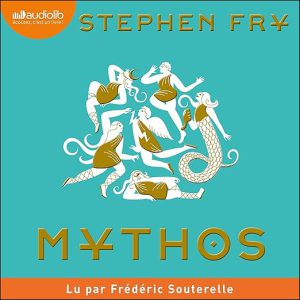
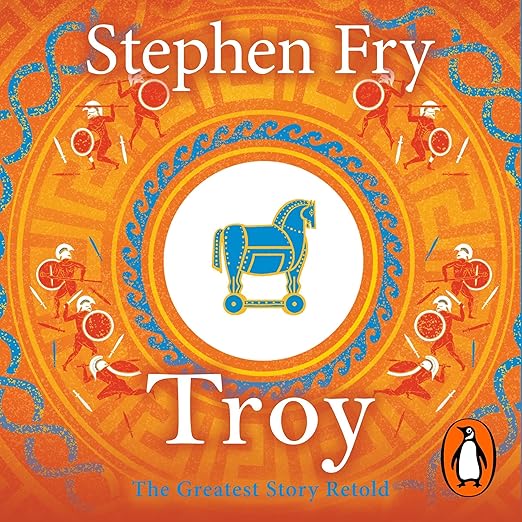
The siege of Troy is a story that has survived thousands of years of retelling, and the difficulty for any modern author is that everyone already knows how it ends. Stephen Fry’s solution is to make the interest lie in causation rather than in outcome. Troy is less a war narrative than a long chain of decisions, grievances, oaths and divine sulks, each one making the next inevitable, so that by the time the wooden horse appears the horror of it has been thoroughly earned.
This is the third volume in Fry’s Greek Myths sequence and, for my money, the most controlled of them. The earlier books had the pleasant sprawl of a collection. Here the material converges. Eleven hours and ten minutes is a great deal of time to spend on a single conflict, and Fry never loses hold of the through line, which given the size of the cast is a considerable feat of organisation.
About the Audiobook
Fry begins well before the ships sail. The book opens with Troy itself, the city that rose and fell not once but twice, and works forward through the tangled genealogies that will eventually place particular people on particular sides. This is the section that surprises most listeners, because the familiar story turns out to have an extremely long prologue. By the time Paris of Troy carries off the Greek queen Helen, the war that follows has already been decades in preparation.
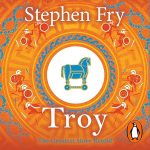
From there the shape is the one you expect and the detail is not. A thousand ships launched against the great city. Trojans standing resolutely against Greek might for an entire decade. The gods interfering constantly, taking sides, changing them again, and treating mortal suffering as an entertainment laid on for their benefit. And finally the wooden horse, delivered to the city in what the publisher fairly calls a masterclass of deception. Fry is unsentimental about the ending. Nobody in this book emerges well.
As the third instalment in Stephen Fry’s Greek Myths, Troy follows the second volume, Heroes, and precedes the fourth and final book, Odyssey, which takes up the aftermath from a single survivor’s point of view. Each volume stands on its own, so beginning here is perfectly workable and the material has a natural completeness to it. Listening in sequence does pay off, though, because several of the figures who arrive fully formed in this book acquired their histories earlier.
The Narration
Fry’s reading here has a different job from the one his other volumes ask of him, and the difference is worth naming. This book carries an enormous cast, most of them related to one another, many with similar names, and all of them nursing grudges that must stay legible across eleven hours. Fry manages it by giving each character a consistent posture rather than an impersonation, so you always know who is speaking without the performance ever collapsing into a parade of voices.
His gods are the highlight. Fry plays Olympian pettiness absolutely straight, which makes it far funnier and considerably more chilling than any amount of arch delivery would have been. When a goddess intervenes, the tone is that of a bored aristocrat rearranging a dinner party, and the mortal cost registers precisely because nobody upstairs registers it at all.
He also knows when to stop being entertaining. The final movement of the book, once the horse is inside the walls, is read with the humour switched off entirely, and the change is severe enough to be genuinely unsettling. Fry wrote this text for his own voice and the sentences confirm it: the asides land where an aside should land, the lists build the way a spoken list needs to build, and the whole would lose a great deal in another reader’s hands.
What Readers Say
Ratings on the UK listing average 4.6 stars, drawn from a modest number of scores, so the written reviews carry more weight here than the figure does. They are enthusiastic and, usefully, quite specific.
A fresh and witty retelling of the classic Trojan tale. Stephen Fry’s style makes the ancient story feel vibrant and accessible, blending humor with deep knowledge.
Louis, awarding five stars, called the result a good mix of entertainment and education, well suited to mythology enthusiasts and to anyone wanting a livelier route into a classic epic. A reviewer writing as Books and Flowers had been waiting for this volume since finishing the second, and described the book as a journey from the origins of the city through to its destruction and the close of an entire heroic age. The most instructive review is the four-star one from Zach Bromfield, who praised the intertwining stories and admitted to learning things he had not known, including details about Paris and about Helen’s children, while feeling that the ending arrived rather abruptly. Having listened to it, I understand the objection. Fry stops where the story stops, with no closing reflection.
Who Should Listen?
Choose this if you want the Trojan War explained rather than merely retold, and if you enjoy watching a good storyteller lay out cause and consequence across a long span. It works well for listeners with only a film-level acquaintance with the material, and equally well for those who know it and want to hear it organised properly for once.
A pair of caveats. This is prose, not poetry, and anyone seeking the sound of Homer will need a verse translation instead. And the content is harsher than the accessible packaging implies: the sack of the city, the treatment of the women taken afterwards, and the deaths of children are all present, handled without gratuitousness but never softened.
As a first encounter with the whole sequence, this volume works better than most, and it can be taken entirely on its own.