Clara’s Verdict
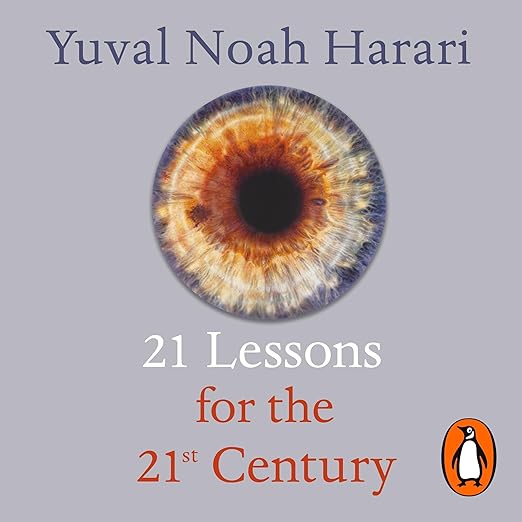
There are books that argue with you, and books that argue with the century itself. Yuval Noah Harari’s 21 Lessons for the 21st Century belongs firmly to the second camp, and I mean that as a compliment. Where his earlier work looked backwards and forwards across vast stretches of time, this one plants both feet in the present and asks the least comfortable question available to us: faced with the mess we have made, are we still capable of understanding the world we have built?
I came to the audiobook expecting a lecture and found something closer to a conversation. Harari does not hand you tidy conclusions. He sets out twenty-one short reflections, on technology, politics, despair and hope, truth and resilience, and lets each one breathe. Some will irritate you. A few may change how you read the news for a fortnight. That, I think, is rather the point.
It is not a flawless listen. The bite-sized structure occasionally leaves a thread hanging just as it grows interesting, and readers who want a single grand thesis may feel the ground shift under them. But as a companion for these bewildering years it is honest, humane and quietly bracing, and I found myself returning to it more than once.
About the Audiobook
In twenty-one short lessons, Harari explores what it means to be human in an age he calls one of bewilderment. The questions he raises are the ones most of us push to the back of the mind because they are simply too large: how do we protect ourselves from nuclear war, ecological collapse and technological disruption? What should we do about the epidemic of fake news, or the persistent threat of terrorism? And, perhaps hardest of all, what on earth should we be teaching our children when the future refuses to hold still?
The golden thread running through the book, as Harari himself frames it, is the challenge of holding our focus, both collective and individual, in the face of constant and disorienting change. He moves between the technological and the political, then turns inward toward questions of meaning, truth and resilience. Bill Gates, writing in the New York Times, called it fascinating and compelling, and credited Harari with teeing up a crucial global conversation. The Guardian described it as truly mind-expanding and ultra-topical.
What I appreciate is that Harari resists the easy comfort of prophecy. He is not selling a five-step plan. He is trying to describe the terrain clearly enough that we might navigate it with our eyes open, and he trusts the listener to do the harder thinking afterwards.
The Narration
Derek Perkins narrates, and he is an inspired match for material like this. Harari’s prose can tip toward the abstract, and a lesser reader might let it drift into monotone. Perkins keeps it grounded. His delivery is measured and articulate, with just enough warmth to remind you that a person is speaking, not a policy document, and he handles the many names, places and technical terms with an unfussy confidence that lets you keep pace with the ideas rather than the pronunciation.
Across eleven hours and forty-two minutes, that steadiness matters. This is not a book to gulp in one sitting; it rewards the daily commute, the long walk, the quiet half hour before sleep. Perkins gives each lesson a clean shape, letting a point land and then pausing before moving on, so the structure of the argument stays legible even when the subject grows knotty. I never once found myself rewinding because I had lost the thread, which, for a book this dense with ideas, is no small praise.
What Readers Say
With an average rating of 4.6 across nineteen ratings, the response from listeners has been notably warm. Several reviewers single out the same quality I did: accessibility. Nuno Picareta called it brilliant, insightful and deeply relevant, praising Harari’s knack for making complex global issues easy to understand, from artificial intelligence and climate change to politics and personal meaning.
Others were struck by its candour. Stuart Aken described it as an unusually truthful book, written in rational prose with a degree of honesty that he felt would startle most readers, and he found the five-part structure clarifying rather than restrictive. Feyzullah Egriboyun, awarding four stars, enjoyed the wit and intellect of the writing and made a point worth repeating: the book does not hand you conclusions, nor does it claim to, but it opens up fresh avenues of consideration. Another listener simply found the choice of topics closely tied to daily life, and came away inspired. It is a small sample, but a consistent one.
Who Should Listen?
This is a listen for the curious and the concerned, for anyone who reads the headlines with a knot of unease and wants a steadier framework for making sense of them. If you enjoyed Harari’s earlier sweep across human history and want to see that same wide-angle mind trained on the present moment, you will feel immediately at home. It also suits book groups and thoughtful commuters, precisely because its short chapters invite discussion and reflection rather than passive consumption.
I would gently steer away anyone hoping for firm answers or a comforting action plan; Harari deals in questions, and he leaves the resolving to you. But if you want a companion that treats you as an intelligent adult and asks you to think harder about the world you actually live in, this one earns its place. You can Listen to 21 Lessons for the 21st Century on Audible and let Derek Perkins guide you through Harari’s twenty-one lessons at whatever pace suits your week.