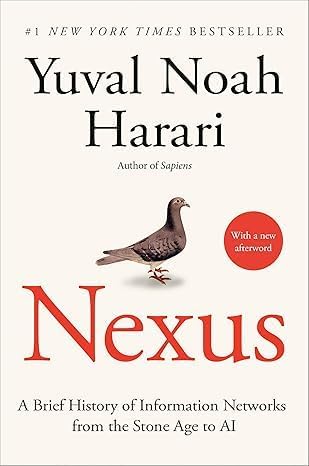
Clara’s Verdict
Yuval Noah Harari has built a career on the long view, and Nexus may be his most ambitious sweep yet. Its subject is deceptively simple: how information moves between us, and what happens to societies when the ways we share knowledge change. From cave paintings to artificial intelligence, Harari traces the invisible architecture that has shaped every civilisation we have ever built, and he does it with the storyteller’s gift for making the abstract feel urgent.
I found it a genuinely stimulating listen, the kind that makes you notice the information networks running quietly through your own day, the phone in your pocket, the headlines on your feed, the calm authority of a printed page. Harari is less interested in gadgets than in consequences: who gains power when a new network appears, who loses it, and what it costs us to know more than any generation before us.
It is a big book of big ideas, and now and then the scope can feel almost too generous. But that ambition is also its pleasure. If you like your non-fiction to reframe the ordinary world rather than merely describe it, Nexus delivers, and it lingers in the mind long after the final chapter.
About the Audiobook
Nexus sets out to tell the sweeping story of how humans have connected, communicated and shared knowledge, from the earliest oral traditions and cave paintings all the way to the global internet and the rise of artificial intelligence. Rather than fixing on a single invention, Harari follows a chain of them, symbols, writing systems, postal routes, telegraphy, the printing press, radio and the digital protocols that now bind the planet together, and shows how each one quietly rewired the society that adopted it.
What gives the book its charge is its refusal to treat any of this as neutral. Harari is as concerned with the social, political and ethical consequences of information networks as he is with their mechanics. He weighs the shadow side, surveillance, shifts in power, unequal access to knowledge, against the extraordinary gains, and he carries that same clear-eyed attention into the present, where the internet, social media and artificial intelligence are reshaping how we think faster than we can easily absorb.
The result is pitched to be genuinely accessible. Clear explanations and well-chosen examples keep the technical developments legible for a general listener, so you do not need a background in history or computing to follow the argument. Its natural audience is broad: students, history enthusiasts, the technically curious, and anyone who wants to understand the forces that shaped the past and are still shaping what comes next.
The Narration
Nexus is a book to be taken in unhurried stretches rather than swallowed whole, and the audio format suits it more than you might expect. A work of this scope lives or dies on clarity, and Harari’s chapters build on one another, each network laying groundwork for the next, so listening actually flatters the design: you carry the thread of one idea into the next walk or journey and feel the argument accumulate.
Non-fiction of this kind can be demanding on the ear when the concepts stack up, yet the writing is structured to help. Points are introduced, illustrated with a concrete example, then drawn to a close before the next begins, which gives a listener natural resting places. My advice is to treat it as a book to think alongside rather than one to leave running in the background; give it your full attention and it repays you generously, chapter by chapter. Keep a quiet stretch of your day for it and the ideas have room to land.
What Readers Say
It is early days for Nexus in terms of listener feedback, and the sample is still small, but the signal so far is strong. The audiobook holds an average rating of 4.7 from five ratings, which places it firmly at the enthusiastic end of the scale. With so few voices in yet, I would treat that figure as an encouraging first impression rather than a settled verdict, the kind of number that suggests early listeners have responded warmly to Harari’s blend of scope and accessibility.
I would rather not put words in anyone’s mouth while the reviews are this sparse. What I can say is that the early rating is consistent with Harari’s wider reputation for turning grand historical questions into something a general audience can genuinely enjoy, and it will be worth watching how that score settles as more listeners work their way through the book.
Who Should Listen?
Nexus is for the intellectually curious: the reader who finished a documentary about the printing press or the internet and wanted to keep pulling the thread. If you are drawn to big-picture history, to the ethics of technology, or simply to understanding how we arrived at an age of algorithms and endless feeds, this will reward you. Students and lifelong learners will find it a clear, well-signposted entry point, and Harari’s admirers will recognise the sweep they came for.
It asks for a little patience, as any book of this ambition must, but it gives that patience back with interest. If you are ready to see the familiar machinery of information in a new light, you can Listen to Nexus: A Brief History of Information Networks from the Stone Age to AI on Audible and let Harari walk you from the first painted symbol to the age of artificial intelligence.