Clara’s Verdict
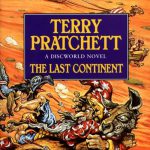
Three voices carry this audiobook and only one of them is doing what you would ordinarily call narration. Colin Morgan reads The Last Continent. Bill Nighy reads the footnotes. Peter Serafinowicz plays Death. James Hannigan has written a new theme tune. All of that is stated in the listing itself rather than inferred, and it is the single strongest reason to take this Discworld novel by ear rather than by eye, because Pratchett’s footnotes are jokes with their own timing and handing them to a separate voice solves a problem the printed page can only solve by making you look down.
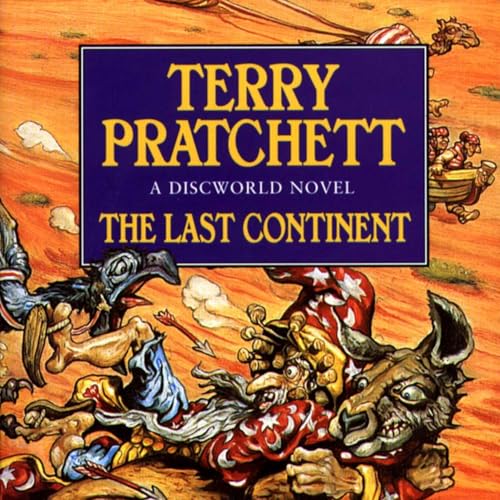
Ten hours and fifty-six minutes, published by Transworld Digital on 7 July 2022 as part of Penguin’s Discworld programme, carrying a 4.6 average across several thousand ratings. This is the twenty-second book in the sequence and one reviewer here places it in the Unseen University sub-series.
About the Audiobook
Rincewind, the description says, is an inept wizard and a reluctant hero, and he has found himself magically stranded on the Discworld’s last continent. The copy’s account of that continent is the best short piece of writing on the page.
It’s hot. It’s dry. There was this thing once called The Wet, which no one believes in any more. Practically everything that’s not poisonous is venomous.
And it is, the copy insists all the same, the best place in the world. In a few days it will die, and the copy breaks off mid-sentence just as it names what stands between the continent and that ending.
Running alongside him is a second plot, which one reviewer describes rather better than the publisher copy does. The faculty of Unseen University, trying to solve a time-related mishap, find themselves marooned on an idyllic tropical island with little food but, in the reviewer’s account, plenty of humour. That reviewer calls it chaos as usual, “made all the more absurd by Pratchett’s spot-on satire of cultural clichés”. That satire is what this novel is best and worst known for. That cliché is the register Pratchett works in for almost the whole book, national stereotype played affectionately but relentlessly. How much you enjoy the book depends heavily on your appetite for that.
The epigraph the publisher chose is the philosophical spine: “Anything you do in the past changes the future. The tiniest little actions have huge consequences. You might tread on an ant now and it might entirely prevent someone from being born in the future.” It is a joke and it is also the plot. On reading order, I would not make this your first Discworld book, but nor do you need the preceding twenty-one. I would treat the other Rincewind titles as the useful preparation, because the running gag here is that he is, in one reviewer’s phrase, “the Discworld’s least competent wizard, a coward of some renown and an expert at running away”, and that gag needs a history behind it to be funny.
The Narration
Colin Morgan is a fine choice for Rincewind specifically, because the character is built out of anxiety and Morgan can play frightened without playing it broadly. The trap with Rincewind is that a reader who leans into the panic turns him into a cartoon, when the comedy actually depends on us believing that his terror is entirely rational, which on the last continent it is.
The division of labour is what makes this production. Nighy on footnotes is not a gimmick. Pratchett uses footnotes as an aside from a second, drier intelligence sitting slightly above the story, and hearing them in a different voice restores exactly the effect the printed page achieves typographically. Serafinowicz’s Death likewise has one fixed job, and having the same voice arrive for it every time gives the character the weight of an institution rather than of a running joke. Hannigan’s theme is a small thing and I would not buy a recording for a piece of music, but it does what a title sequence does, which is tell you what kind of room you have walked into.
What Readers Say
That average sits comfortably high without being adulatory, and the written responses are correspondingly affectionate rather than reverent. The most useful of them opens with the honest admission “I enjoyed the book but it’s not my favourite Discworld book”, and then goes on to praise the plot anyway. That combination is the correct reading of where this one sits.
The second reviewer is a returning reader rather than a new one, describing a re-read after some years away and concluding that “The magic is still there and he’s still the only author that keeps me glued to page chuckling away”. The third supplies context rather than opinion, noting that Pratchett was born in 1948, was the best-selling author in the United Kingdom through the 1990s, won the Carnegie Award and received an OBE and a knighthood for services to literature, before placing this book as the twenty-second in the series and part of the Unseen University sub-series.
What none of the three does is discuss the recording. All are responding to the novel as read on the page, one of them explicitly on a Kindle, so the average carries no information at all about Morgan, Nighy or Serafinowicz. Take the 4.6 as a verdict on Pratchett and judge the production separately, ideally from a sample that includes at least one footnote.
Who Should Listen?
Twenty-second in a sequence sounds forbidding and is not. If you have read any of the Rincewind books, this is an easy and very funny eleven hours, and the three-voice production is the best argument I know for revisiting Discworld in audio even if the paperbacks are already on your shelf. Anyone with a soft spot for the Unseen University faculty gets a full subplot of them stranded, hungry and arguing, which is the faculty at their very best.
I would steer two groups away. Anyone starting Discworld from nothing should begin somewhere earlier, since the humour here leans on a character the earlier books have already established. And anyone who finds extended national caricature wearing should understand that it is not a passing gag here. It is the whole setting, sustained for the full running time.