Clara’s Verdict
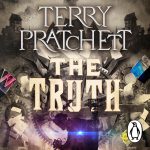
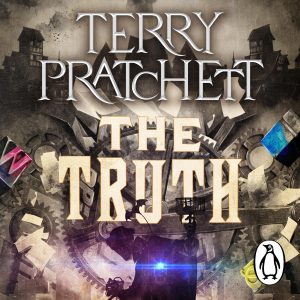
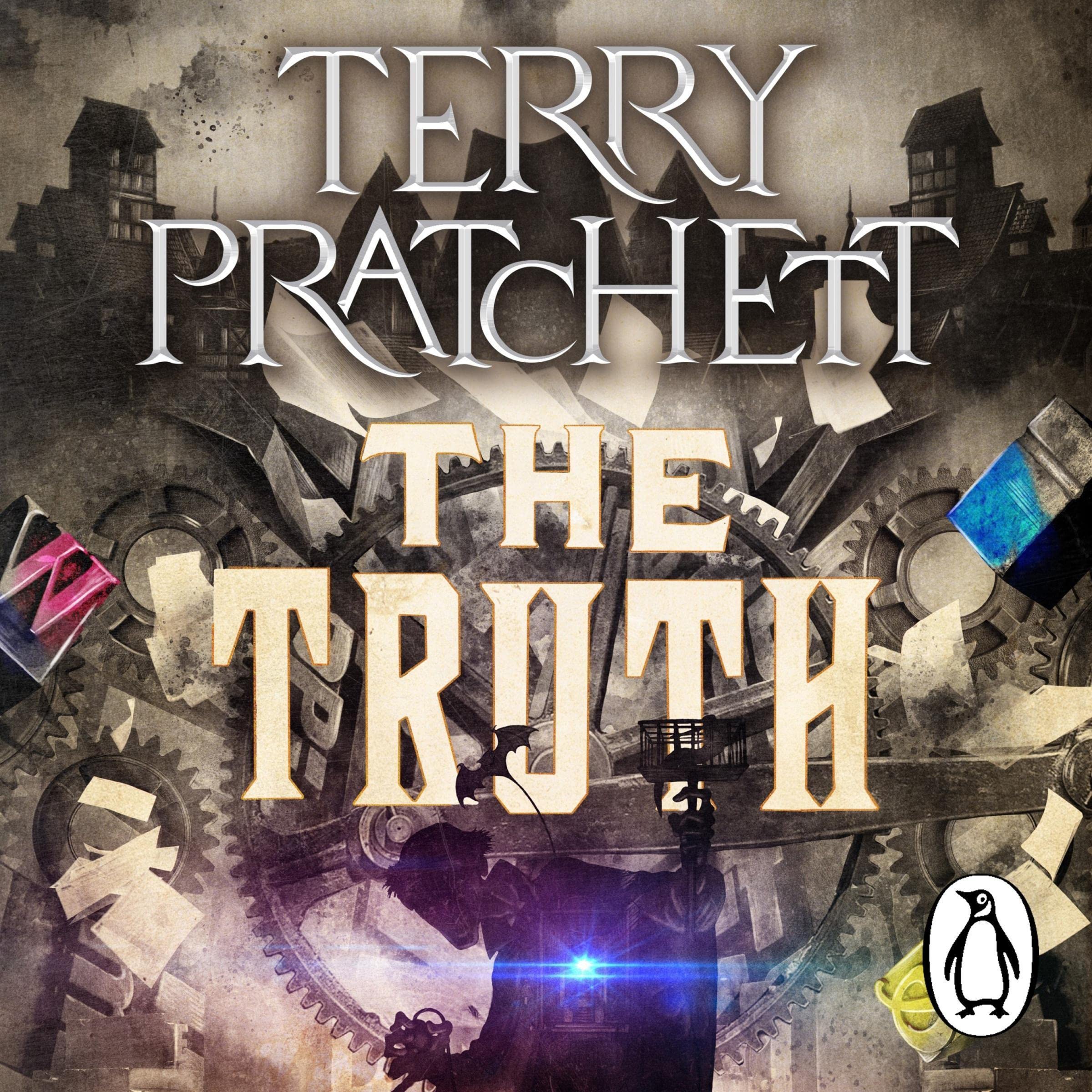
The publisher’s description carries a line from the novel itself: “A lie can run round the world before the truth has got its boots on”. That is the whole audiobook folded into a single sentence. William de Worde becomes the accidental editor of the Discworld’s first newspaper and learns very quickly that the machinery of print has no particular interest in whether what it prints is accurate. Terry Pratchett published it in 2000. It has aged into something uncomfortably close to a briefing document.
My verdict is that this is among the most welcoming entries in the whole sequence, and Transworld’s own copy agrees: the description states plainly that the Discworld novels can be read in any order and that The Truth is a standalone. The subject helps. You do not need to know a thing about Discworld politics to follow a man discovering that people will believe almost anything once it has been set in type, and Mathew Baynton reads the satire as comedy first, which is the correct decision.
About the Audiobook
Twelve hours and sixteen minutes. The listing names Transworld Digital as publisher while the description credits Penguin Audio for the 2023 recording, which is worth knowing if you are matching editions. This is the twenty-fifth Discworld novel, a long way into the run, though as I have said, the publisher is explicit that order is optional in this case.
The premise runs on collision. William has a job. The job attracts, in the comic accounting of the description, people who would like him dead, a second set of people who would like him dead by other means, a recovering vampire with a dangerous enthusiasm for flash photography, and a man who will not stop begging for his oddly shaped potatoes to be photographed. That last detail is the one I would point to if someone asked me what Pratchett actually does. The threats and the potatoes are given the same weight, because a newspaper gives them the same weight, and the joke and the argument turn out to be the same thing.
The Times, quoted in the publisher’s copy, called it “an unmitigated delight” and “very, very funny”, and I would not argue with either half. What the copy does not say, and what I think matters more, is that this is one of the angrier Discworld novels underneath the farce. William wants the truth; as the copy puts it, everyone else wants to get at William. Pratchett was writing about proprietors, deniability and the manufacture of public belief a quarter of a century ago, and the reason the book has not dated is that nothing it describes has stopped happening.
The Narration
Mathew Baynton is the only performer credited here, and the description points to no additional cast, so treat it as a single-reader recording.
Twelve hours with one voice is a real assignment for this particular book, because of the tonal range the description itself advertises. Threats to the editor’s life and a man with amusingly shaped potatoes sit in the same paragraph of publisher copy, which tells you how fast the register has to move; the comic rhythm depends on the reader knowing which of the two modes he is in at any given moment, sometimes within the same sentence. Baynton’s instinct is to keep the surface light and let the darker material land by contrast rather than by pushing, and that is what I would want. When a Pratchett reader signals the jokes, the jokes stop working.
The ensemble is where a single voice on Discworld either succeeds or does not, and even from the description alone the range is clear: the young editor at the centre of it, a recovering vampire with a fascination for flash photography, and the various parties who want the editor dead. Baynton separates them by manner more than by pitch, which is the harder and more durable technique across twelve hours. My one reservation is that the pace occasionally runs a little ahead of the prose in the busier scenes, and Pratchett is a writer whose sentences reward being given room. That is a small complaint about a reading I enjoyed a great deal.
What Readers Say
Seven thousand and ninety ratings at an average of 4.7 is a strong showing, and it is worth saying where that number comes from. One of the three reviews attached to the listing was posted in September 2018, more than four years before this recording existed, so a portion of the score belongs to the novel’s earlier life in print. That does not make the average less useful. It does mean it is telling you about Pratchett rather than about Baynton.
The reviews themselves are short and fond. One, posted in April 2026, calls the book “Typical Terry Pratchett” and “hard to put down”, and its title carries a note of regret that there will be no more of them. Another, headed simply Good present, reports it “Funny and a brilliant read”. The most interesting of the three comes from Mr Tim Kirby, who gets at something specific about the prose:
Prachett’s excels at writing things in a way that has a little twist to them (Like Adams). his use of the language has me rereading a sentence or paragraph just for the joy of it.
I have kept his typing exactly as posted. The Adams comparison is well made, and the second half of it raises the one real question about taking this book in audio: rereading a sentence for the joy of it is a page reader’s pleasure, and audio turns it into a deliberate act rather than an instinct. You can rewind. You will not do it as often. What audio gives you in exchange is the timing, which in Pratchett is at least half the joke. None of the three reviewers discusses the reading at all, which is a gap I would fill by listening to a sample before committing twelve hours.
Who Should Listen?
If you have never opened a Discworld novel and have been put off by the sheer length of the series, this is a sensible door. The publisher says so, the subject needs no prior briefing, and the satire is aimed at an institution you already know intimately. If you have worked in newspapers, or still do, expect the recognition to be sharp enough to sting. And if you are going through the series properly, book twenty-five finds Pratchett squarely in the business of writing about how institutions actually behave.
I would hesitate in two cases. Anyone who wants their comic fantasy broad and quick will find twelve hours of dense, allusive, sentence-level wit hard going. And anyone whose favourite thing about Pratchett is the printed page and the pleasure of doubling back may find a single-voice reading trades away something they value. Everyone else should get on with it.