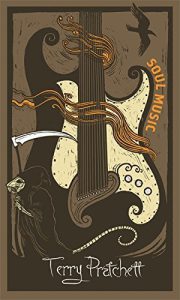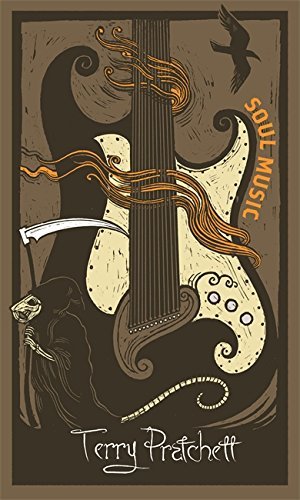
Clara’s Verdict
Somebody in the production office looked at a Terry Pratchett novel, noticed the footnotes, and hired Bill Nighy to read them. I would like to shake that person’s hand. Soul Music is a three-performer audiobook: Sian Clifford narrates, Peter Serafinowicz plays Death, Nighy takes the footnotes, and James Hannigan has written a new theme tune for it. Four credits, four separate decisions, and not one of them is the obvious one.
Transworld Digital put the recording out on 27 October 2022. It runs eleven hours and twenty-two minutes, sits at 4.6 across 7,035 ratings, and is numbered sixteenth in Discworld. The casting is what makes this edition worth choosing, and the footnote decision in particular is the smartest piece of thinking on the listing.
About the Audiobook
Two things are set running here and then allowed to collide. The first is Susan. “Being sixteen is always difficult, but it’s even more so when there’s a Death in the family.” Her upbringing has been anything but normal, involving “a skeletal grandfather who rides a white horse and wields a scythe”, and the household changes when the old man decides he is owed a holiday: “When Death decides he needs a well-earned break, he leaves Susan to take over the family business.” The immediate difficulty is that “everyone mistakes her for the Tooth Fairy”.
The second is the music. Something new and addictive has arrived in Discworld, and the copy is blunt about what it does: “It’s lawless. It changes people. It’s got a beat and you can dance to it.” The best line on the whole listing is the epigraph: “This didn’t feel like magic. It felt a lot older than that. It felt like music.”
One honest note about the listing itself. The description stops mid-word. It gets as far as “It’s called Music With Ro” and breaks off there. I am not going to complete it for you, because I would be guessing, but you should know that the copy on the listing is truncated and not finished, and that whatever else it was going to say about this book is simply missing.
Sixteen books into Discworld sounds forbidding, and it is not. Susan, her grandfather and her predicament all arrive from a standing start, which is as clear a signal as a description can give that the book was built to be picked up. Anyone who prefers to go in sequence now knows where it sits.
The Narration
Start with the footnotes, because they are the interesting problem. In print, a footnote is a small act of collaboration: your eye drops, takes the joke, and comes back, and you control the timing entirely. In audio the digressions have to interrupt the sentence, and any narrator faced with them has to decide whether to swallow them, signpost them or drop them altogether. Giving them to a separate actor is the elegant answer. It should turn an awkward structural device into a running gag with a personality, and it means each interruption arrives as a change of voice, not a change of tone.
Casting Death separately is the other good decision. The description treats Death as a part to be played and not a voice for a narrator to drop into, and asking one performer to keep switching into it across a recording this long is a strain that tends to show. Handing it to Peter Serafinowicz means the voice can be built rather than approximated, and it means any exchange between Susan and her grandfather is a genuine two-hander instead of one voice answering itself.
That leaves Sian Clifford with the bulk of the work, and the hardest part of it is Susan herself. A sixteen-year-old handed the family scythe is easy to get wrong in either direction: play her too young and the comedy turns twee, play her too knowing and she loses the awkwardness the plot depends on. Deadpan without boredom is a narrow target, and most performers miss on one side or the other.
The commissioned theme tune is the final signal. It tells you that somebody treated this as a production, and it sets an expectation for the whole listen. Everything I have said in this section is an assessment of casting rather than of performance, because not a single review attached here has left a word about how the three of them actually sound.
What Readers Say
The reviews here are about Pratchett rather than about this edition. Gadget Carousel writes the sharpest of them: “Pratchett’s clever, satirical writing shines here as he parodies everything from rock culture and fandoms to the mysterious allure of fame.” The same review argues that the book “doesn’t just offer laughs but digs into the bittersweet truths about art, identity, and the weight of legacy”, which is a fair account of what separates this one from straightforward comic fantasy.
Schmikey, at four stars, singles out the character who anchors the whole thing: “I really enjoyed the development of the Susan Death character, Sir Terry does female characters so well and that’s no mean achievement in this genre.” The same review calls the novel “huge fun, full of crazy characters and the brilliant laugh out loud puns”, and notes the sadness that now attaches to reading Pratchett at all. It dates from 2016, so it is a verdict on the novel and not on this cast.
The third review, from althea, is a reread rather than a listen: a warm few lines about revisiting a Pratchett favourite, about an author sadly missed, and about how much of it still raises a laugh. It tells you nothing about this recording, but it tells you something about the way these books get returned to.
So all three of these reviews are describing the text, and the earliest of them predates this recording by more than six years. If you want confirmation that this particular production works before committing eleven hours to it, the commentary on this listing will not supply it and a sample will.
Who Should Listen?
Discworld regulars who have only ever heard single-voice readings will find this a genuinely different proposition, and the footnote conceit is worth the experiment by itself. It will particularly reward anyone who enjoys satire aimed at music culture, fame and fandom, which is exactly what Gadget Carousel identifies in it.
One group should not buy this edition: listeners who want a single voice in their ear for eleven hours. This one splits the work three ways and adds a commissioned theme tune, which is a real change to the reading experience and not everybody wants it. If you also want a full product description before you commit, wait for one. The book will still be there, and so will Bill Nighy.